Bitcoin’s Power Shift: New Whales Now Control The Market
Bitcoin has slipped below the $90,000 level as markets react to rising macroeconomic tension between the United States and the European Union, with fresh concerns tied to geopolitical friction around Greenland. The renewed risk-off tone pressured equities and crypto alike, reinforcing Bitcoin’s sensitivity to global headlines when uncertainty spikes and investors reduce exposure across high-beta assets.
Beyond price action, on-chain data suggests a deeper shift is taking place inside the Bitcoin market. A report by analyst MorenoDV highlights that, for the first time in history, “new whales” now account for a larger share of Bitcoin’s Realized Cap than long-term “OG” whales. Realized Cap tracks the aggregate cost basis of coins based on their last on-chain movement, meaning this change signals that a substantial portion of BTC supply has recently changed hands at higher prices.

This transfer of influence matters because it reshapes short-term supply dynamics. When newer large holders dominate realized capital, market behavior can become more reactive, with marginal supply increasingly controlled by investors who entered later in the cycle and may be more sensitive to volatility. As Bitcoin battles to reclaim $90,000, this evolving whale structure may help explain why rebounds feel less stable and why selling pressure can reappear quickly during macro-driven pullbacks.
New Whales Now Dictate Bitcoin’s Short-Term Direction
Realized Cap measures Bitcoin’s aggregate cost basis by valuing coins at the price of their last on-chain movement. When this metric shifts toward new whales—short-term holder whales holding more than 1,000 BTC with UTXO age below 155 days—it signals that a meaningful share of supply has recently changed hands at elevated prices. In other words, market control is moving away from experienced, cycle-tested holders and toward capital that arrived late in the trend.
This transition helps explain Bitcoin’s current behavior. The realized price of new whales sits near $98,000, while spot price continues trading below that level. As a result, this cohort is estimated to be carrying roughly $6 billion in unrealized losses. These losses are not just paper drawdowns—they shape decision-making and increase sensitivity to volatility, especially during sharp corrections.

On-chain realized PnL data suggests that since the market peak, new whales have driven the bulk of realized losses. During the recent drawdown, they repeatedly sold into weakness and used brief rebounds to exit positions. Reflecting risk management rather than conviction.
Old whales tell the opposite story. With a realized price around $40,000, long-term whales remain deeply profitable. Their activity has been limited relative to the flows coming from new whales. For now, Bitcoin’s direction is being dictated by this newer, more fragile whale cohort.
Bitcoin Breaks Below Key Support
Bitcoin is showing renewed weakness after losing the $90,000 psychological level, with price now trading near $88,300 on the daily chart. The structure reflects a clear downtrend from the late-2025 highs, followed by a failed attempt to recover. After a sharp drop in November, BTC stabilized and built a short consolidation base, but the rebound into early January lacked follow-through and quickly turned into another rejection.
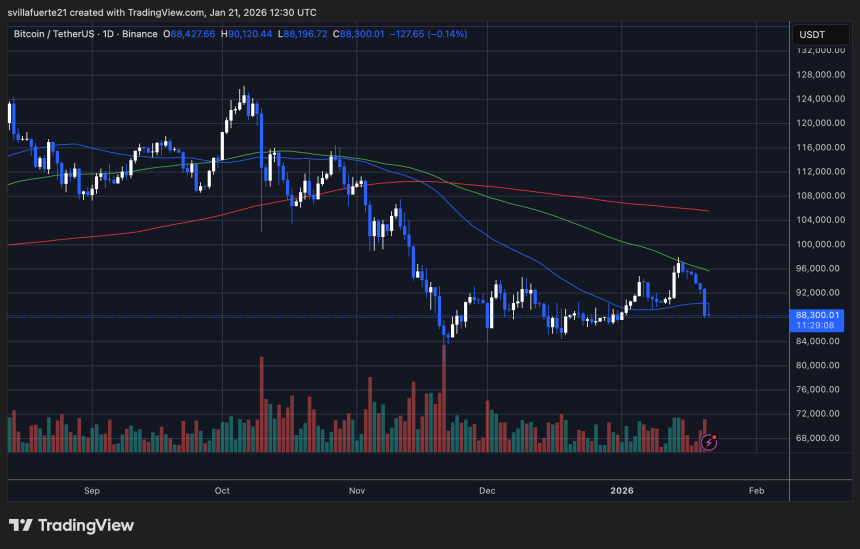
From a technical perspective, BTC remains trapped below its major moving averages, which are now acting as dynamic resistance. The shorter-term average has rolled over sharply, while the broader trend line above continues to slope downward. Signaling that momentum remains capped, and sellers are still in control on rallies. The recent bounce toward the mid-$90K region was rejected aggressively, confirming that overhead supply remains heavy and buyers are not yet strong enough to flip the trend.
Volume patterns support this narrative. The biggest spikes occurred during the selloff leg, showing forced activity and distribution. While the most recent recovery attempts have been met with weaker participation. As long as Bitcoin stays below the $90K–$92K zone, price action suggests the market is still searching for a stable bottom. The downside risk remains elevated if fear accelerates across the broader crypto market.
Featured image from ChatGPT, chart from TradingView.com
You May Also Like

Q4 2025 May Have Marked the End of the Crypto Bear Market: Bitwise

WWE Royal Rumble 2026: Confirmed Entrants, Updated Card