THE word “brutal” isn’t exactly one we would normally use to describe a good lunch, but a restaurant in Quezon City might just change that. A boy’s christening THE word “brutal” isn’t exactly one we would normally use to describe a good lunch, but a restaurant in Quezon City might just change that. A boy’s christening

Food and architecture

THE word “brutal” isn’t exactly one we would normally use to describe a good lunch, but a restaurant in Quezon City might just change that.

A boy’s christening in January held at and catered by Brutal by Wadoughs brought us into the orbit of chef Wado Siman, who transitioned from a career in television, pastry, then restaurant consultancy (their initial patisserie, Wadough’s in Maginhawa, has a degree of online fame). Brutal is Mr. Siman’s first venture into a full-service restaurant, opening late in 2024. “I hope you had a brutally good time,” he said in a text message.

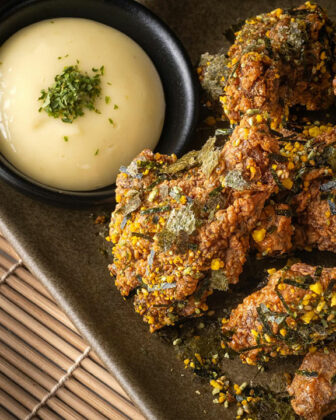
During our lunch at Brutal, we had the pleasure of sipping their Talaba Chowder, and the soup made us forget we were at a family gathering and we began to work. For one thing, the flavor of oysters, delicate as it was, was still clearly expressed in the chunky soup, a rarity in this city. There were their signature wings, coated with nori and a hint of wasabi in the mayo dip, though this sat behind the Inasal Ribs. Think of the flavors in Bacolod’s chicken inasal (barbecue): earthy annatto and lively lemongrass, but given a heavier, more filling texture in pork ribs. Their Callos (beef tripe stewed in tomato sauce) was a surprise. It was clean-tasting, eliminating the sometimes-gamey taste of tripe that puts off other people. It dispensed with the tomato sauce, so the result was a clean and light dish, with just a hint of fragrant spice (Mr. Siman said that the recipe comes from Quezon where he grew up; incorporating Lucban longanisa sausage and kiping, a local rice wafer). There was a beef kare-kare (meat stewed in peanut sauce) too, with a sauce thinner than the ones served in other restaurants — which might seem a disadvantage, but here, it gained home-cooked familiarity.

Just as well: the space in Quezon City was once occupied by his mother’s former food venture.

The name derives from the building’s Brutalist architecture. The postwar Brutalist style became popular in the Marcos years (1965-1986) in the Philippines, characterized by angular shapes executed in concrete (think of the Cultural Center of the Philippines and the Philippine International Convention Center). Around the world, it became shorthand for Cold War style, but it was also favored for its economy in a world rebuilding after the Second World War and the haste to industrialize in a Cold War world. While it has its detractors for its supposed coldness and monumental inapproachability, some have become attached to it due to its clean lines and no-fuss attitude.

“My mom used to have a Filipino restaurant, but not really highlighting or emphasizing the Brutalist exterior since it was a low-end restaurant, so they didn’t care much about how the outside looks like,” he told BusinessWorld. For him though, “Brutal is such a powerful word, but naisip ko din na (I thought that) when you translate it to food, it can be very straightforward, unapologetic, and then in-your-face, no fuss, no muss, good food,” he said. “We wanted something more comfortable and straightforward,” he said, noting that they didn’t aspire for something “out-of-this-world” or “genius high end.” “We wanted to be not intimidating comfort food that you can eat or consume every day.”

Brutal is located at No. 6 Sto. Tomas corner Nicanor Ramirez St., Quezon City. Reservations can be made through Instagram at @brutalbywadoughs. The restaurant is open from 7 a.m. to 11 p.m. daily. — Joseph L. Garcia

Market Opportunity
Manchester City Fan Logo
Manchester City Fan Price(CITY)
$0.6076
$0.6076$0.6076
-0.42%
USD
Manchester City Fan (CITY) Live Price Chart
Disclaimer: The articles reposted on this site are sourced from public platforms and are provided for informational purposes only. They do not necessarily reflect the views of MEXC. All rights remain with the original authors. If you believe any content infringes on third-party rights, please contact [email protected] for removal. MEXC makes no guarantees regarding the accuracy, completeness, or timeliness of the content and is not responsible for any actions taken based on the information provided. The content does not constitute financial, legal, or other professional advice, nor should it be considered a recommendation or endorsement by MEXC.

You May Also Like

The Channel Factories We’ve Been Waiting For

The Channel Factories We’ve Been Waiting For

The post The Channel Factories We’ve Been Waiting For appeared on BitcoinEthereumNews.com. Visions of future technology are often prescient about the broad strokes while flubbing the details. The tablets in “2001: A Space Odyssey” do indeed look like iPads, but you never see the astronauts paying for subscriptions or wasting hours on Candy Crush.  Channel factories are one vision that arose early in the history of the Lightning Network to address some challenges that Lightning has faced from the beginning. Despite having grown to become Bitcoin’s most successful layer-2 scaling solution, with instant and low-fee payments, Lightning’s scale is limited by its reliance on payment channels. Although Lightning shifts most transactions off-chain, each payment channel still requires an on-chain transaction to open and (usually) another to close. As adoption grows, pressure on the blockchain grows with it. The need for a more scalable approach to managing channels is clear. Channel factories were supposed to meet this need, but where are they? In 2025, subnetworks are emerging that revive the impetus of channel factories with some new details that vastly increase their potential. They are natively interoperable with Lightning and achieve greater scale by allowing a group of participants to open a shared multisig UTXO and create multiple bilateral channels, which reduces the number of on-chain transactions and improves capital efficiency. Achieving greater scale by reducing complexity, Ark and Spark perform the same function as traditional channel factories with new designs and additional capabilities based on shared UTXOs.  Channel Factories 101 Channel factories have been around since the inception of Lightning. A factory is a multiparty contract where multiple users (not just two, as in a Dryja-Poon channel) cooperatively lock funds in a single multisig UTXO. They can open, close and update channels off-chain without updating the blockchain for each operation. Only when participants leave or the factory dissolves is an on-chain transaction…
Share
BitcoinEthereumNews2025/09/18 00:09
Ripple (XRP) CEO Brad Garlinghouse Makes Another Statement Regarding the Anticipated US Cryptocurrency Legislation

Ripple (XRP) CEO Brad Garlinghouse Makes Another Statement Regarding the Anticipated US Cryptocurrency Legislation

Ripple CEO Brad Garlinghouse, in his latest statement, once again expressed his support for the cryptocurrency legislation being debated in the US. Continue Reading
Share
Coinstats2026/01/22 05:30
Trump Dismisses Stock Market Dip as Minor While Solana and XRP Stand to Gain

Trump Dismisses Stock Market Dip as Minor While Solana and XRP Stand to Gain

Trump calls stock market dip “peanuts” and predicts big gains for Solana and XRP, despite recent market volatility and geopolitical tensions. President Donald Trump
Share
LiveBitcoinNews2026/01/22 06:00