

Must Read
PHILIPPINE CHIEF. President Ferdinand Marcos Jr. in Malacañang.PHILIPPINE CHIEF. President Ferdinand Marcos Jr. in Malacañang.
[Vantage Point] The solar tale: Jurisprudence slays Leviste’s thinly veiled tact
Leandro Leviste has vociferously rejected allegations that he illegally sold the franchise of his solar energy company to the Manny Pangilinan-led Meralco group for personal gain. With a simple truth that dismantles Leviste’s technical denials and corporate distancing, this column exposes the central failure of his clean-energy empire: that permissions were turned into profit, while power delivery collapsed.
Whether or not a franchise was formally sold misses the point entirely. Thousands of megawatts were promised, monetized, and traded long before they were built — leaving consumers to shoulder the cost of delay, with regulators scrambling only after public scrutiny forced action. In a sector where every missed deadline carries a price, we argue that this was not a misunderstanding of law, but a breakdown of accountability — one that reveals how easily infrastructure can be converted into financial exit when enforcement comes too late.
In recent weeks, Batangas 1st District Representative Leandro Legarda Leviste has launched a near-constant media offensive. From prime-time television interviews to radio call-ins, livestreams, and daily social-media posts, the freshman congressman has made himself nearly omnipresent just as his solar companies began facing government penalties.
The message is consistent: he did not sell a franchise; the company that held it no longer operates; the Meralco group bought a different entity, and the accusations are misguided. The repetition is deliberate. But Vantage Point believes that saturation is not persuasion and that in public life, credibility is not built by airtime but by coherence. The more Leviste speaks, the clearer it becomes that his defense relies on technical fragments rather than a full accounting of what unfolded.
The controversy confronting him was never about whether a franchise document changed hands. It was about whether regulatory permission — granted early, amplified by political proximity, and accumulated across related entities — was transformed into private value before public obligations were fulfilled.
Framing the issue as a literal sale of a franchise may be convenient, but it sidesteps the deeper concern: how a clean-energy platform was monetized, while delivery lagged far behind. It is that gap — between promise and performance — that no amount of explanation can dissolve.
Where Leviste’s defense falls short
Leviste’s defense revolves around a narrowing strategy. He insists he did not sell a franchise. He emphasizes that Solar Para sa Bayan Corporation (SPBC), the grantee of Republic Act 11357’s 25-year franchise, is now defunct. He notes that SP New Energy Corp. (SPNEC), the listed company acquired by the Meralco group, is legally separate and distinct. Each claim, taken individually, may be accurate. Together, they attempt to convert a systemic failure into a debate over corporate labels.
But infrastructure does not fail on paper. It fails in real time — when megawatts promised in planning models do not arrive, when reserve margins tighten, and when consumers absorb higher costs not through a surcharge but through everyday bills. In regulated industries, outcomes matter more than architecture.
Philippine jurisprudence has long recognized this distinction. Courts have succinctly held that when corporate structures are used to obscure economic reality or defeat public policy, analysis must move beyond form and examine substance. The law does not reward fragmentation when fragmentation exists only to dilute accountability.
A congressional franchise is not a mere document. It is a state-granted economic privilege that confers early access to regulated territory, credibility with investors, and leverage in project development. Its value lies not in whether it is sold, but in what it enables. Once such permission exists, it shapes land acquisition, service-contract origination, and market expectation long before any asset becomes operational.
This is why the argument that SPBC ceased operations in 2022 does not resolve the controversy. Republic Act 11357 was enacted in 2019, during the Rodrigo Duterte administration, at a time when renewable energy access was scarce and regulatory positioning carried enormous value. For several critical years, that franchise existed while land was consolidated, projects mapped, and capacity promised. Corporate dormancy cannot retroactively erase advantages already extracted.
Nor does the insistence that SPNEC is “separate and distinct” from SPBC answer the core question. Courts do not accept separateness as a mantra. They examine whether entities share beneficial ownership, pursue a common commercial objective, and transfer value — tangible or intangible — across corporate lines. When those elements align, formal boundaries lose their force.
Substance over form is not a slogan, but settled law
Philippine jurisprudence has long rejected defenses built purely on corporate compartmentalization. In Kukan International Corp. v. Reyes (G.R. No. 182729, 2010), the Supreme Court reaffirmed that when corporate structures are used to defeat public convenience or shield parties from accountability, courts are duty-bound to look beyond form and examine substance.
The Court’s reasoning is clear: legal separateness cannot be invoked when it becomes an instrument of injustice.
That principle has been reiterated in cases involving public utilities and franchises, where the Court has consistently ruled that state-granted privileges must be interpreted in light of public interest, not private structuring.
Economic reality
A franchise is not merely a statutory document. It is a public concession — and as I’ve earlier explained, an extraordinary permission to operate in a sector where entry is otherwise restricted. In ABS-CBN Broadcasting Corp. v. Comelec (G.R. No. 133486), the Court emphasized that franchises are imbued with public interest and cannot be treated as ordinary corporate assets divorced from their social function.
That doctrine matters here.
Leviste argues that SPBC, the holder of the Republic Act 11357 grant, ceased operations in 2022 and that the franchise therefore has become irrelevant. But jurisprudence does not evaluate privileges retroactively.
In Republic v. Meralco (G.R. No. 141314), the Court ruled that benefits derived from a franchise during its effective period remain legally and economically relevant even if later circumstances change. You cannot deny the effect of authority simply because it no longer exists at the moment scrutiny begins.
In plain terms: a privilege enjoyed cannot be disowned once it has served its purpose.
Timing is not a footnote, but the case
Republic Act 11357 was enacted in 2019, during the Duterte administration, when Leviste’s mother, Senator Loren Legarda, was a sitting lawmaker. That fact alone proves nothing illegal — but in jurisprudence, timing determines consequence.
From 2019 to 2022, that franchise existed during the formative period of Leviste’s renewable-energy expansion. Land was consolidated. Solar zones were identified. Service contracts multiplied. Market expectations formed. By the time the franchise holder became dormant, the ecosystem it enabled had already taken shape.
Courts have consistently held that corporate restructuring after value creation does not negate accountability for how that value arose. In Concept Builders v. NLRC (G.R. No. 108734), the Supreme Court ruled that when one corporation is used to avoid obligations incurred through another, the veil may be pierced even absent fraud, if public policy is compromised.
That is precisely the issue regulators now confront.
Leviste repeatedly emphasizes that SPNEC, the company sold to Meralco’s renewable unit, is “separate and distinct” from SPBC. But legal separateness is not conclusive. It is evidentiary.
Courts ask whether entities share ownership, control, purpose, and benefit. When these align, separateness becomes fiction.
This is why jurisprudence refers not to corporate form, but to economic unity.
Markets understand this instinctively. Investors did not value SPNEC based on steel already standing in the field. They valued it based on pipeline, permissions, scale, and projected capacity — expectations rooted in regulatory access.
What was monetized was not electricity. It was belief.
Why divestment does not dissolve responsibility
Leviste also argues that penalties imposed by the Department of Energy (DOE) should be directed at SPNEC, now controlled by Meralco, because he has already divested.
That defense fails under long-settled doctrine.
In Cruz v. Dalisay (G.R. No. 146303), the Supreme Court held that liability does not evaporate simply because ownership changes after obligations are incurred. Responsibility attaches at the moment commitments are made, not when consequences arrive.
Infrastructure contracts are not day trades. They bind timelines, public planning, and national security assumptions.
The DOE’s own data shows that nearly 12,000 megawatts of renewable capacity associated with Leviste-linked entities failed to come online as scheduled — roughly 63% of canceled capacity in the 2024-2025 enforcement sweep. Actual delivery hovered near 2%.
From my vantage point, this is not a criminal charge, but more of governance failure. And governance failures in utilities carry consequences far beyond corporate balance sheets.
Why consumers paid long before penalties arrived
Electricity pricing does not wait for investigations to conclude. Grid planning assumes awarded capacity will be delivered. When megawatts do not arrive, the system compensates through higher-cost dispatch and thinner reserves.
There is no surcharge labeled “undelivered solar.” The cost appears structurally — spread across the system.
This is why the DOE itself has estimated that, had canceled renewable contracts been delivered, electricity prices could have been roughly ₱2 per kilowatt-hour lower by 2030. That difference reflects capacity that existed in planning models, but not in reality.
In Tatad v. Secretary of Energy (G.R. No. 124360), the Supreme Court warned that energy policy failures ultimately burden consumers, and that regulatory discretion must be exercised with urgency precisely because delay has economic cost.
That warning now reads less like theory and more like prophecy.
Enforcement after exposure is not reform
What troubles markets most is not that penalties were eventually imposed. It is that enforcement required public pressure to occur.
By October 2025, missed milestones were already evident. Projects were dormant. Deadlines had lapsed. None of this was hidden. Yet the system moved slowly, treating accumulation of nonperformance as administrative friction rather than systemic risk.
It took the Vantage Point exposé to force the question regulators had deferred: how did so much promised power become monetizable before it was ever built? Only then did penalties harden. Only then did accountability accelerate. But jurisprudence is clear: enforcement that arrives after damage is not deterrence — it is admission.
Why this was never about a franchise
Leviste’s defense focuses on what he did not do. He did not sell a franchise. He did not own the company at penalty time. He did not control operations anymore.
But public-utility law does not ask what was not done. It asks what resulted:
- Permissions were granted.
- Capacity was promised.
- Execution failed.
- Value was monetized.
- Consumers absorbed the cost.
No corporate rearrangement changes that sequence.
This column does not allege illegality. It asserts something more fundamental: that Philippine infrastructure governance remains vulnerable when permission is rewarded faster than performance.
Clean energy cannot function as a speculative asset class. It must function as infrastructure.
Until execution — not access, not proximity, not narrative — becomes the currency of credibility, our country will continue repeating the same cycle: promise first, enforcement later, and the public paying in between.
That is why this was never about a franchise. It was about whether the system rewards building — or merely being early enough to sell the idea of it. And that is the true reckoning that Philippine energy policy can no longer postpone. – Rappler.com
Related Vantage Point articles on the Leandro Leviste solar energy business:
- [Vantage Point] The Leviste gambit: Monetizing clean energy for political gains?
- [Vantage Point] The Leviste solar saga – why markets should be worried
- [Vantage Point] Consumers pay for DOE’s delayed action on Leviste firms
Some recent Vantage Point articles on green energy and sustainable financing:
- [Vantage Point] The truth about net-zero emissions
- [Vantage Point] BPI’s blue bonds: Saving our seas or rebranding an old development gap?
- [Vantage Point] Why the Philippines should slow down on offshore wind transition
Click here for other Vantage Point articles.
Market Opportunity
PrompTale AI Price(TALE)
$0.001159
$0.001159$0.001159
USD
PrompTale AI (TALE) Live Price Chart
Disclaimer: The articles reposted on this site are sourced from public platforms and are provided for informational purposes only. They do not necessarily reflect the views of MEXC. All rights remain with the original authors. If you believe any content infringes on third-party rights, please contact [email protected] for removal. MEXC makes no guarantees regarding the accuracy, completeness, or timeliness of the content and is not responsible for any actions taken based on the information provided. The content does not constitute financial, legal, or other professional advice, nor should it be considered a recommendation or endorsement by MEXC.
You May Also Like

Adoption Leads Traders to Snorter Token
The post Adoption Leads Traders to Snorter Token appeared on BitcoinEthereumNews.com. Largest Bank in Spain Launches Crypto Service: Adoption Leads Traders to Snorter Token Sign Up for Our Newsletter! For updates and exclusive offers enter your email. Leah is a British journalist with a BA in Journalism, Media, and Communications and nearly a decade of content writing experience. Over the last four years, her focus has primarily been on Web3 technologies, driven by her genuine enthusiasm for decentralization and the latest technological advancements. She has contributed to leading crypto and NFT publications – Cointelegraph, Coinbound, Crypto News, NFT Plazas, Bitcolumnist, Techreport, and NFT Lately – which has elevated her to a senior role in crypto journalism. Whether crafting breaking news or in-depth reviews, she strives to engage her readers with the latest insights and information. Her articles often span the hottest cryptos, exchanges, and evolving regulations. As part of her ploy to attract crypto newbies into Web3, she explains even the most complex topics in an easily understandable and engaging way. Further underscoring her dynamic journalism background, she has written for various sectors, including software testing (TEST Magazine), travel (Travel Off Path), and music (Mixmag). When she’s not deep into a crypto rabbit hole, she’s probably island-hopping (with the Galapagos and Hainan being her go-to’s). Or perhaps sketching chalk pencil drawings while listening to the Pixies, her all-time favorite band. This website uses cookies. By continuing to use this website you are giving consent to cookies being used. Visit our Privacy Center or Cookie Policy. I Agree Source: https://bitcoinist.com/banco-santander-and-snorter-token-crypto-services/
Share
BitcoinEthereumNews2025/09/17 23:45
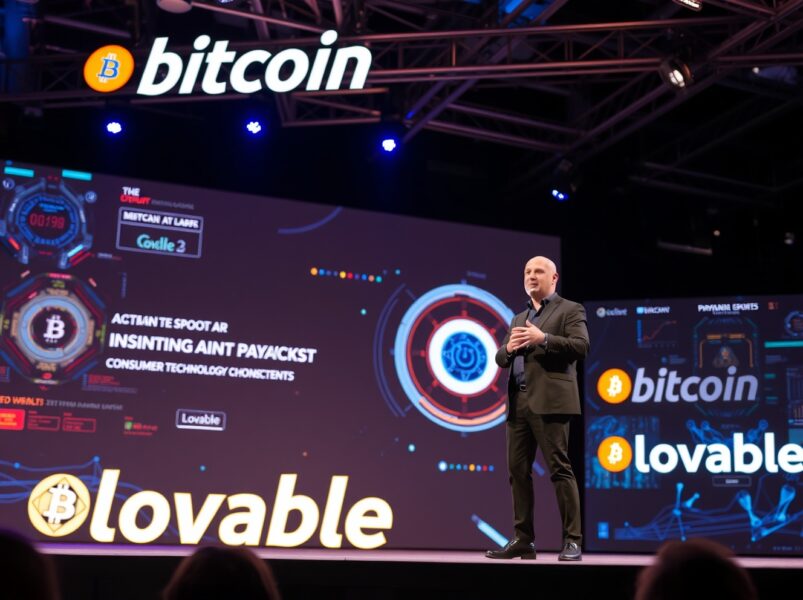
Lovable AI’s Astonishing Rise: Anton Osika Reveals Startup Secrets at Bitcoin World Disrupt 2025
BitcoinWorld Lovable AI’s Astonishing Rise: Anton Osika Reveals Startup Secrets at Bitcoin World Disrupt 2025 Are you ready to witness a phenomenon? The world of technology is abuzz with the incredible rise of Lovable AI, a startup that’s not just breaking records but rewriting the rulebook for rapid growth. Imagine creating powerful apps and websites just by speaking to an AI – that’s the magic Lovable brings to the masses. This groundbreaking approach has propelled the company into the spotlight, making it one of the fastest-growing software firms in history. And now, the visionary behind this sensation, co-founder and CEO Anton Osika, is set to share his invaluable insights on the Disrupt Stage at the highly anticipated Bitcoin World Disrupt 2025. If you’re a founder, investor, or tech enthusiast eager to understand the future of innovation, this is an event you cannot afford to miss. Lovable AI’s Meteoric Ascent: Redefining Software Creation In an era where digital transformation is paramount, Lovable AI has emerged as a true game-changer. Its core premise is deceptively simple yet profoundly impactful: democratize software creation. By enabling anyone to build applications and websites through intuitive AI conversations, Lovable is empowering the vast majority of individuals who lack coding skills to transform their ideas into tangible digital products. This mission has resonated globally, leading to unprecedented momentum. The numbers speak for themselves: Achieved an astonishing $100 million Annual Recurring Revenue (ARR) in less than a year. Successfully raised a $200 million Series A funding round, valuing the company at $1.8 billion, led by industry giant Accel. Is currently fielding unsolicited investor offers, pushing its valuation towards an incredible $4 billion. As industry reports suggest, investors are unequivocally “loving Lovable,” and it’s clear why. This isn’t just about impressive financial metrics; it’s about a company that has tapped into a fundamental need, offering a solution that is both innovative and accessible. The rapid scaling of Lovable AI provides a compelling case study for any entrepreneur aiming for similar exponential growth. The Visionary Behind the Hype: Anton Osika’s Journey to Innovation Every groundbreaking company has a driving force, and for Lovable, that force is co-founder and CEO Anton Osika. His journey is as fascinating as his company’s success. A physicist by training, Osika previously contributed to the cutting-edge research at CERN, the European Organization for Nuclear Research. This deep technical background, combined with his entrepreneurial spirit, has been instrumental in Lovable’s rapid ascent. Before Lovable, he honed his skills as a co-founder of Depict.ai and a Founding Engineer at Sana. Based in Stockholm, Osika has masterfully steered Lovable from a nascent idea to a global phenomenon in record time. His leadership embodies a unique blend of profound technical understanding and a keen, consumer-first vision. At Bitcoin World Disrupt 2025, attendees will have the rare opportunity to hear directly from Osika about what it truly takes to build a brand that not only scales at an incredible pace in a fiercely competitive market but also adeptly manages the intense cultural conversations that inevitably accompany such swift and significant success. His insights will be crucial for anyone looking to understand the dynamics of high-growth tech leadership. Unpacking Consumer Tech Innovation at Bitcoin World Disrupt 2025 The 20th anniversary of Bitcoin World is set to be marked by a truly special event: Bitcoin World Disrupt 2025. From October 27–29, Moscone West in San Francisco will transform into the epicenter of innovation, gathering over 10,000 founders, investors, and tech leaders. It’s the ideal platform to explore the future of consumer tech innovation, and Anton Osika’s presence on the Disrupt Stage is a highlight. His session will delve into how Lovable is not just participating in but actively shaping the next wave of consumer-facing technologies. Why is this session particularly relevant for those interested in the future of consumer experiences? Osika’s discussion will go beyond the superficial, offering a deep dive into the strategies that have allowed Lovable to carve out a unique category in a market long thought to be saturated. Attendees will gain a front-row seat to understanding how to identify unmet consumer needs, leverage advanced AI to meet those needs, and build a product that captivates users globally. The event itself promises a rich tapestry of ideas and networking opportunities: For Founders: Sharpen your pitch and connect with potential investors. For Investors: Discover the next breakout startup poised for massive growth. For Innovators: Claim your spot at the forefront of technological advancements. The insights shared regarding consumer tech innovation at this event will be invaluable for anyone looking to navigate the complexities and capitalize on the opportunities within this dynamic sector. Mastering Startup Growth Strategies: A Blueprint for the Future Lovable’s journey isn’t just another startup success story; it’s a meticulously crafted blueprint for effective startup growth strategies in the modern era. Anton Osika’s experience offers a rare glimpse into the practicalities of scaling a business at breakneck speed while maintaining product integrity and managing external pressures. For entrepreneurs and aspiring tech leaders, his talk will serve as a masterclass in several critical areas: Strategy Focus Key Takeaways from Lovable’s Journey Rapid Scaling How to build infrastructure and teams that support exponential user and revenue growth without compromising quality. Product-Market Fit Identifying a significant, underserved market (the 99% who can’t code) and developing a truly innovative solution (AI-powered app creation). Investor Relations Balancing intense investor interest and pressure with a steadfast focus on product development and long-term vision. Category Creation Carving out an entirely new niche by democratizing complex technologies, rather than competing in existing crowded markets. Understanding these startup growth strategies is essential for anyone aiming to build a resilient and impactful consumer experience. Osika’s session will provide actionable insights into how to replicate elements of Lovable’s success, offering guidance on navigating challenges from product development to market penetration and investor management. Conclusion: Seize the Future of Tech The story of Lovable, under the astute leadership of Anton Osika, is a testament to the power of innovative ideas meeting flawless execution. Their remarkable journey from concept to a multi-billion-dollar valuation in record time is a compelling narrative for anyone interested in the future of technology. By democratizing software creation through Lovable AI, they are not just building a company; they are fostering a new generation of creators. His appearance at Bitcoin World Disrupt 2025 is an unmissable opportunity to gain direct insights from a leader who is truly shaping the landscape of consumer tech innovation. Don’t miss this chance to learn about cutting-edge startup growth strategies and secure your front-row seat to the future. Register now and save up to $668 before Regular Bird rates end on September 26. To learn more about the latest AI market trends, explore our article on key developments shaping AI features. This post Lovable AI’s Astonishing Rise: Anton Osika Reveals Startup Secrets at Bitcoin World Disrupt 2025 first appeared on BitcoinWorld.
Share
Coinstats2025/09/17 23:40

Q2 Market Insights: Bitcoin regains dominance in risk-averse environment, ETFs remain critical to market structure
The market will show a downward trend in the short term, and then rebound and set new highs in the second half of the year.
Share
PANews2025/04/28 19:40