ACX, the native token of Across Protocol, has dropped sharply following serious allegations of insider self-dealing involving $23 million in decentralized autonomous organization funds. The token is trading at $0.1342, down 10% in the past 24 hours and over 40%…ACX, the native token of Across Protocol, has dropped sharply following serious allegations of insider self-dealing involving $23 million in decentralized autonomous organization funds. The token is trading at $0.1342, down 10% in the past 24 hours and over 40%…

Across Protocol token plunges amid allegations of $23M misappropriation by team

2025/06/27 14:28

ACX, the native token of Across Protocol, has dropped sharply following serious allegations of insider self-dealing involving $23 million in decentralized autonomous organization funds.

The token is trading at $0.1342, down 10% in the past 24 hours and over 40% in the past month. It’s now 91% below its all-time high of $1.69 set in December 2024.

The allegations were made public on June 27 by Ogle, the pseudonymous founder of Layer 1 project Glue and advisor to World Liberty Financial. In a detailed post on X, Ogle accused the Across Protocol team, particularly project lead Kevin Chan and chief executive officer Hart Lambur, of orchestrating two secretive proposals that directly benefited their own company using undisclosed wallets.

These proposals, made to appear as having community support, transferred 150 million ACX tokens worth about $23 million at current prices to Risk Labs over two separate governance votes. The first vote in October 2023 granted 100 million ACX under the pretense of future development support, with claims that the tokens would not be sold for two years.

But soon after, Risk Labs allegedly began selling token option agreements to external investors  A second vote, for “retroactive funding” of 50 million ACX, passed primarily due to insider-controlled wallets. Without those votes, it would not have reached quorum.

The report argues that such actions run counter to DAO governance principles and create significant future sell pressure, especially harmful to ACX holders unaware of the conflicts of interest behind these decisions. Across Protocol has not publicly responded to the allegations at the time of writing.

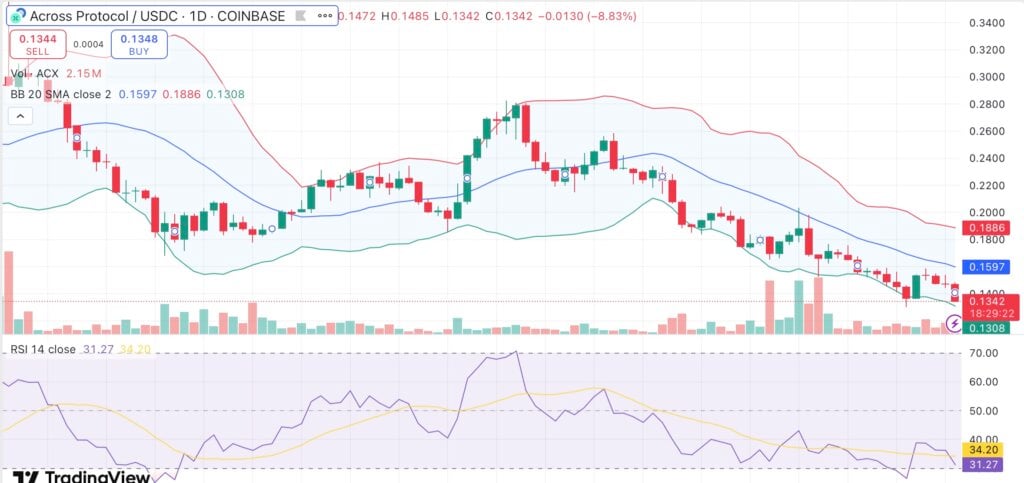
Looking at the technical picture, the chart shows clear downward pressure. The token is currently hugging the lower Bollinger Band at $0.1308 and trading below its 20-day simple moving average of $0.1597. At 31.27, the relative streghth index, which is trending downwards, is close to oversold territory.
Across Protocol token plunges amid allegations of $23M misappropriation by team - 1

More declines may occur if the price breaks through the $0.13 support zone. Some investors may watching for a bounce move back toward the mid-Bollinger band despite the sell-off. However, in the short term, upward momentum might be limited due to deteriorating sentiment and eroded trust in the team.

Disclaimer: The articles reposted on this site are sourced from public platforms and are provided for informational purposes only. They do not necessarily reflect the views of MEXC. All rights remain with the original authors. If you believe any content infringes on third-party rights, please contact [email protected] for removal. MEXC makes no guarantees regarding the accuracy, completeness, or timeliness of the content and is not responsible for any actions taken based on the information provided. The content does not constitute financial, legal, or other professional advice, nor should it be considered a recommendation or endorsement by MEXC.

You May Also Like

BlackRock boosts AI and US equity exposure in $185 billion models

BlackRock boosts AI and US equity exposure in $185 billion models

The post BlackRock boosts AI and US equity exposure in $185 billion models appeared on BitcoinEthereumNews.com. BlackRock is steering $185 billion worth of model portfolios deeper into US stocks and artificial intelligence. The decision came this week as the asset manager adjusted its entire model suite, increasing its equity allocation and dumping exposure to international developed markets. The firm now sits 2% overweight on stocks, after money moved between several of its biggest exchange-traded funds. This wasn’t a slow shuffle. Billions flowed across multiple ETFs on Tuesday as BlackRock executed the realignment. The iShares S&P 100 ETF (OEF) alone brought in $3.4 billion, the largest single-day haul in its history. The iShares Core S&P 500 ETF (IVV) collected $2.3 billion, while the iShares US Equity Factor Rotation Active ETF (DYNF) added nearly $2 billion. The rebalancing triggered swift inflows and outflows that realigned investor exposure on the back of performance data and macroeconomic outlooks. BlackRock raises equities on strong US earnings The model updates come as BlackRock backs the rally in American stocks, fueled by strong earnings and optimism around rate cuts. In an investment letter obtained by Bloomberg, the firm said US companies have delivered 11% earnings growth since the third quarter of 2024. Meanwhile, earnings across other developed markets barely touched 2%. That gap helped push the decision to drop international holdings in favor of American ones. Michael Gates, lead portfolio manager for BlackRock’s Target Allocation ETF model portfolio suite, said the US market is the only one showing consistency in sales growth, profit delivery, and revisions in analyst forecasts. “The US equity market continues to stand alone in terms of earnings delivery, sales growth and sustainable trends in analyst estimates and revisions,” Michael wrote. He added that non-US developed markets lagged far behind, especially when it came to sales. This week’s changes reflect that position. The move was made ahead of the Federal…
Share
BitcoinEthereumNews2025/09/18 01:44
Western Union Eyes Stablecoin Card for Inflation Zones

Western Union Eyes Stablecoin Card for Inflation Zones

The post Western Union Eyes Stablecoin Card for Inflation Zones appeared on BitcoinEthereumNews.com. Western Union is building a stablecoin-backed prepaid card targeting countries with high inflation rates. Summary Western Union is creating a stablecoin-backed prepaid card for inflation-heavy economies. The USDPT token on Solana launches in 2026, integrating with the firm’s remittance network. Partnership with Rain enables Visa stablecoin cards and crypto-to-cash conversions. The money transfer giant plans to offer the product in markets where local currency depreciation erodes purchasing power, CFO Matthew Cagwin told the UBS Global Technology and AI conference. Cagwin pointed to Argentina as a prime use case, where inflation exceeded 200% last year. The dollar-denominated card would help preserve value for remittance recipients in economies facing rapid currency devaluation. Rain partnership brings Visa stablecoin cards Western Union has partnered with Rain to issue Visa cards linked to stablecoins. The collaboration allows users to convert digital assets stored in wallets connected to Rain’s platform into local cash at Western Union branches. The company is building on-ramps and off-ramps within its digital asset network to reduce banking system dependence and accelerate fund settlement. “We’re working with several providers to build this infrastructure,” Cagwin stated. Western Union plans to launch the US Dollar Payment Token (USDPT) in 2026, a stablecoin issued by Anchorage Digital on the Solana network. The token will integrate with the company’s broader digital asset strategy. The prepaid card will function as a bridge between stablecoins and everyday spending in high-inflation economies. Users receive remittances loaded onto cards denominated in dollars. The cards can be spent at merchants or withdrawn as cash at Western Union locations. Company reverses decade-long crypto skepticism Western Union maintained a dismissive stance toward cryptocurrencies for years. In 2017, Chief Technology Officer David Thompson questioned Bitcoin’s viability as currency, comparing crypto to commodities rather than functional money. The company argued that digital assets lacked governance,…
Share
BitcoinEthereumNews2025/12/07 02:47