The situation on our roads has moved from confusion to outright chaos. At the center of the issue now are light electric vehicles (LEVs), the mobility savior of the poor and the marginalized but, to an extent, also the bane of public safety and traffic management. If I recall correctly, last April authorities started restricting […]The situation on our roads has moved from confusion to outright chaos. At the center of the issue now are light electric vehicles (LEVs), the mobility savior of the poor and the marginalized but, to an extent, also the bane of public safety and traffic management. If I recall correctly, last April authorities started restricting […]

Same roads, shared rules, shared accountability

2025/12/04 00:03

The situation on our roads has moved from confusion to outright chaos. At the center of the issue now are light electric vehicles (LEVs), the mobility savior of the poor and the marginalized but, to an extent, also the bane of public safety and traffic management.

If I recall correctly, last April authorities started restricting LEVs from major roads in Metro Manila. Then came a “grace period.” Then a suspension of some rules. Then a warning-only phase. Now we are witnessing yet another “deferral” of strict enforcement to January 2026.

The Land Transportation Office (LTO) threatens impoundment. Legislators threaten congressional probes. The Metro Manila Development Authority (MMDA) stands in the middle of a traffic jam that is as much legal as it is physical, with no clear untangling in sight.

The government insists a ban is necessary to curb what it claims is a spike in LEV-related accidents since before the pandemic. Legislators and civil society groups counter that banning e-bikes and e-trikes from national roads without first building proper infrastructure hits the poor hardest.

What makes things more difficult is our penchant for responding to issues piecemeal. One rule for tricycles. Another rule, then suspension, for e-trikes. A “warning only” period for December. Different treatment for the same vehicle as it crosses from Quezon City into Manila. The result is confusion and chaos in the streets.

The regulatory environment should not change constantly with the wind or with every administration. We need to step back and check if some basic principles still apply: If it is on the road, then it should be in the system. And if it can hurt people, then it should not be invisible to the law.

The premise is that anything used on a public, shared road should have some form of legal identity, with its user or operator having some degree of accountability. In this line, anything that uses the same road should also be covered by the same rules, or at least similar ones.

It will help if we update the Land Transportation and Traffic Code, or Republic Act 4136, which is already 61 years old. We cannot continue to referee a modern game using rules written in 1964. Its logic is too simplistic: if it is not powered by muscle, then it is a “motor vehicle.” And if it is using a public road, then it must be registered. If it is not registered, then it is illegal on the road.

From a safety perspective, this is an acceptable argument. If an e-bike or e-trike is propelled by a motor and is running on a public road, then why should it be treated differently from a motorcycle or a tricycle? In this regard, perhaps the LTO has a point, some basis, in restricting or banning LEVs from national roads.

But a newer law, the Electric Vehicle Industry Development Act (EVIDA) of 2022, promotes electric mobility by exempting certain LEVs for “exclusive private use” from LTO registration. It also requires the government to provide segregated lanes for LEVs on major and local national roads.

Unless this legal deadlock is untangled, and unless we clarify whether a later, special law repeals or modifies an older, general one, our streets will remain dangerous and the public will remain confused. How do we resolve this tug-of-war between public safety and sustainability? Is it fair to have the same rules apply to everybody?

Early on, the LTO tried to clear matters up with Administrative Order 2021-039, which classified EVs into categories based on speed and configuration. Some categories required registration and licensing, others did not. It was not perfect, but it was a starting point. However, even that order was eventually suspended.

Rather than choosing safety or inclusivity, perhaps we should consider a new, unified national framework that reconciles all existing laws and gives clear guidance to authorities and road users alike. Such a framework should not deprive the poor and the marginalized of accessible mobility options. Improving road safety should not come at the expense of people’s mobility.

The safety argument is real. Physics matters. A flimsy, open-frame e-trike moving at 20 kilometers per hour is structurally incompatible with a bus or SUV moving at 60 kph on EDSA. The speed difference alone is a recipe for catastrophe.

At the same time, since low-speed LEVs currently do not require registration or licensing, many riders, including minors, are on the road with no formal knowledge of traffic rules, signals, or right of way. Viral videos of e-trikes counter-flowing, swerving across lanes, or driving on sidewalks have fed the perception that these vehicles are dangerous and their users undisciplined.

But for thousands of Filipinos, e-bikes and e-trikes are survival tools. They fill the “mobility vacuum” left by an unwieldy public transport system. The combination of transport shortages, high fuel prices, and crowded rail lines pushes many ordinary workers into LEVs because they are cheaper and more reliable.

So, if we prohibit e-bikes or e-trikes from crossing or traversing national roads, we create what researchers call “mobility islands.” A mother living on one side of EDSA may not legally cross to the market on the other side using the only vehicle she can afford. A delivery rider using an e-bike may be forced to detour through side streets to avoid apprehension, resulting in fewer deliveries and less income.

As I have written previously, the crux of the matter is that necessity heeds no law. If policy makers ignore the economic reality that these LEVs are a lifeline for the poor, then any ban will simply be observed in breach. Obviously, enforcers cannot monitor all roads all the time, and LEVs will win the cat-and-mouse game.

We should consider a clear and concise national standard that defines what LEVs are, where they can go, how they should be equipped, and what obligations their users must meet. Local governments can then add layers to address local conditions, but they should align with a clear national baseline.

Congress has proposed a national bicycle law. But the conversation has already moved on. We now have e-scooters, pedal-assist bikes, cargo e-trikes, stand-up scooters, skateboards, and other personal mobility devices of varying speeds and weights, all on our roads alongside LEVs and other vehicles.

In this line, we urgently need a unified land transport code that reflects the world we live in now, not the world as it looked in 1964 or even 10 years ago. The central questions are still basic: Who is allowed on the road? Under what conditions? Who is responsible when something goes wrong? How do we make people accountable? How do we ensure public safety? How do we efficiently use limited road space?

For anything on the road other than pedestrians, I believe the basic expectations for public road use should be the same. If something occupies space on a public road at significant speed, it presents risk, and that risk must be managed. But can we actually apply “no training (license), no plates (registration), no insurance (CTPL), no travel” to all types of mobility options on the road?

The problem is that almost every day, motorists encounter e-trikes or e-bikes counter-flowing, swerving across lanes, squeezing between cars and sidewalks, or riding on pedestrian paths. Many of these riders are minors. Most are unlicensed. If these LEVs get hit by a registered, insured vehicle, then the vehicle owner is liable. But if LEVs cause an accident, they are often anonymous, unregistered, and uninsured.

This is not about discriminating against the poor. It is about accountability and fairness. Poor road design and hostile conditions are a given. All road users must be made accountable for behavior that endangers anyone. The reality is that an untrained rider on an unregulated vehicle in mixed traffic is a danger to themselves and to others.

When I say same roads, shared rules, this does not mean we treat an e-bike exactly like an SUV. It means anyone who uses a vehicle that can injure others should be visible to the system and should meet a basic threshold of responsibility. We need fair rules on safety and accountability.

Bicycles and LEVs should all be treated as serious vehicles. If they are given space, then they should also have rules. Users should be made responsible and accountable for how they behave on the road. And we can do this only if we have a unified, harmonized law and set of rules to govern all types of land transport.

We should also take into consideration existing laws or initiatives that mandate the government to build segregated lanes for electric vehicles, including LEVs, and bicycles on major and local roads. Government should not penalize the public for its own failure to do this, or to provide efficient mass transit systems.

Until a new land transport code is in place, perhaps a system of segregation and regularization will work. Designated roads and lanes for bicycles, LEVs, and personal mobility devices (PMDs) should be a must, with safe crossings and proper signals. The LTO can also consider a simplified, low-cost registration or tagging tier for bicycles, LEVs, and PMDs, perhaps with matching third-party liability coverage. The goal is not to burden the poor, but to bring them into the legal system so that everyone is better protected.

More than anything, cities should, first and foremost, be walkable. The rights of motorists, LEV users, cyclists, and PMD users should not take priority over those of people on foot. Pedestrians are the most vulnerable in any collision. They deserve the strongest protection in both law and design.

In the same manner, pedestrians must use crossings where available, obey signals, and avoid sudden jaywalking that puts both themselves and motorists at risk. This requires stronger local enforcement and some degree of liability on the part of jaywalkers.

I go back to what I still believe is the fairest arrangement: all types of land transportation should be subject to the same basic expectations because they all enjoy the same basic privilege, which is to use public roads. If it is on the road, it should be registered or at least recognized. And if we expect safety, we must demand responsibility and accountability from everyone, including pedestrians.

We share the same roads. It is time we also shared clear, consistent, and fair rules on how to use them.

Marvin Tort is a former managing editor of BusinessWorld, and a former chairman of the Philippine Press Council

[email protected]

Disclaimer: The articles reposted on this site are sourced from public platforms and are provided for informational purposes only. They do not necessarily reflect the views of MEXC. All rights remain with the original authors. If you believe any content infringes on third-party rights, please contact [email protected] for removal. MEXC makes no guarantees regarding the accuracy, completeness, or timeliness of the content and is not responsible for any actions taken based on the information provided. The content does not constitute financial, legal, or other professional advice, nor should it be considered a recommendation or endorsement by MEXC.

You May Also Like

BetFury is at SBC Summit Lisbon 2025: Affiliate Growth in Focus
BetFury is at SBC Summit Lisbon 2025: Affiliate Growth in Focus

The post BetFury is at SBC Summit Lisbon 2025: Affiliate Growth in Focus appeared on BitcoinEthereumNews.com. Press Releases are sponsored content and not a part of Finbold’s editorial content. For a full disclaimer, please . Crypto assets/products can be highly risky. Never invest unless you’re prepared to lose all the money you invest. Curacao, Curacao, September 17th, 2025, Chainwire BetFury steps onto the stage of SBC Summit Lisbon 2025 — one of the key gatherings in the iGaming calendar. From 16 to 18 September, the platform showcases its brand strength, deepens affiliate connections, and outlines its plans for global expansion. BetFury continues to play a role in the evolving crypto and iGaming partnership landscape. BetFury’s Participation at SBC Summit The SBC Summit gathers over 25,000 delegates, including 6,000+ affiliates — the largest concentration of affiliate professionals in iGaming. For BetFury, this isn’t just visibility, it’s a strategic chance to present its Affiliate Program to the right audience. Face-to-face meetings, dedicated networking zones, and affiliate-focused sessions make Lisbon the ideal ground to build new partnerships and strengthen existing ones. BetFury Meets Affiliate Leaders at its Massive Stand BetFury arrives at the summit with a massive stand placed right in the center of the Affiliate zone. Designed as a true meeting hub, the stand combines large LED screens, a sleek interior, and the best coffee at the event — but its core mission goes far beyond style. Here, BetFury’s team welcomes partners and affiliates to discuss tailored collaborations, explore growth opportunities across multiple GEOs, and expand its global Affiliate Program. To make the experience even more engaging, the stand also hosts: Affiliate Lottery — a branded drum filled with exclusive offers and personalized deals for affiliates. Merch Kits — premium giveaways to boost brand recognition and leave visitors with a lasting conference memory. Besides, at SBC Summit Lisbon, attendees have a chance to meet the BetFury team along…
Share
BitcoinEthereumNews2025/09/18 01:20
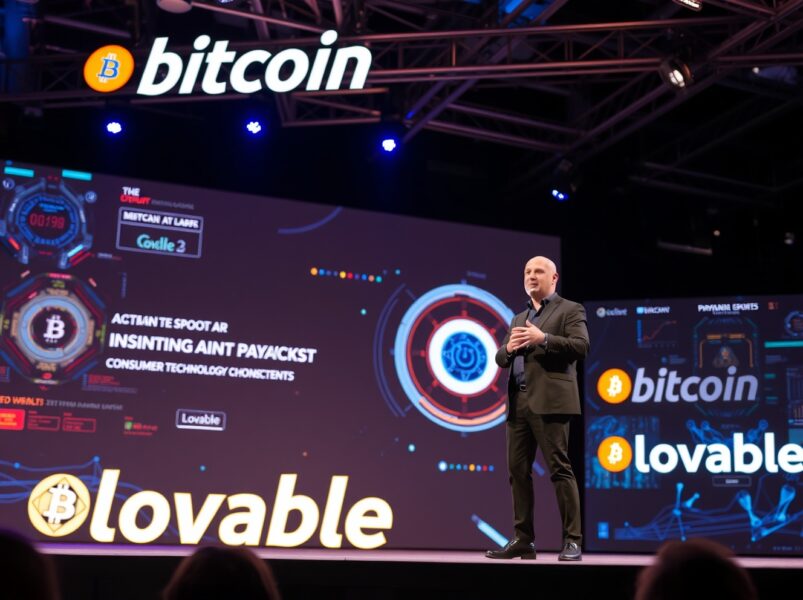
Lovable AI’s Astonishing Rise: Anton Osika Reveals Startup Secrets at Bitcoin World Disrupt 2025

Lovable AI’s Astonishing Rise: Anton Osika Reveals Startup Secrets at Bitcoin World Disrupt 2025

BitcoinWorld Lovable AI’s Astonishing Rise: Anton Osika Reveals Startup Secrets at Bitcoin World Disrupt 2025 Are you ready to witness a phenomenon? The world of technology is abuzz with the incredible rise of Lovable AI, a startup that’s not just breaking records but rewriting the rulebook for rapid growth. Imagine creating powerful apps and websites just by speaking to an AI – that’s the magic Lovable brings to the masses. This groundbreaking approach has propelled the company into the spotlight, making it one of the fastest-growing software firms in history. And now, the visionary behind this sensation, co-founder and CEO Anton Osika, is set to share his invaluable insights on the Disrupt Stage at the highly anticipated Bitcoin World Disrupt 2025. If you’re a founder, investor, or tech enthusiast eager to understand the future of innovation, this is an event you cannot afford to miss. Lovable AI’s Meteoric Ascent: Redefining Software Creation In an era where digital transformation is paramount, Lovable AI has emerged as a true game-changer. Its core premise is deceptively simple yet profoundly impactful: democratize software creation. By enabling anyone to build applications and websites through intuitive AI conversations, Lovable is empowering the vast majority of individuals who lack coding skills to transform their ideas into tangible digital products. This mission has resonated globally, leading to unprecedented momentum. The numbers speak for themselves: Achieved an astonishing $100 million Annual Recurring Revenue (ARR) in less than a year. Successfully raised a $200 million Series A funding round, valuing the company at $1.8 billion, led by industry giant Accel. Is currently fielding unsolicited investor offers, pushing its valuation towards an incredible $4 billion. As industry reports suggest, investors are unequivocally “loving Lovable,” and it’s clear why. This isn’t just about impressive financial metrics; it’s about a company that has tapped into a fundamental need, offering a solution that is both innovative and accessible. The rapid scaling of Lovable AI provides a compelling case study for any entrepreneur aiming for similar exponential growth. The Visionary Behind the Hype: Anton Osika’s Journey to Innovation Every groundbreaking company has a driving force, and for Lovable, that force is co-founder and CEO Anton Osika. His journey is as fascinating as his company’s success. A physicist by training, Osika previously contributed to the cutting-edge research at CERN, the European Organization for Nuclear Research. This deep technical background, combined with his entrepreneurial spirit, has been instrumental in Lovable’s rapid ascent. Before Lovable, he honed his skills as a co-founder of Depict.ai and a Founding Engineer at Sana. Based in Stockholm, Osika has masterfully steered Lovable from a nascent idea to a global phenomenon in record time. His leadership embodies a unique blend of profound technical understanding and a keen, consumer-first vision. At Bitcoin World Disrupt 2025, attendees will have the rare opportunity to hear directly from Osika about what it truly takes to build a brand that not only scales at an incredible pace in a fiercely competitive market but also adeptly manages the intense cultural conversations that inevitably accompany such swift and significant success. His insights will be crucial for anyone looking to understand the dynamics of high-growth tech leadership. Unpacking Consumer Tech Innovation at Bitcoin World Disrupt 2025 The 20th anniversary of Bitcoin World is set to be marked by a truly special event: Bitcoin World Disrupt 2025. From October 27–29, Moscone West in San Francisco will transform into the epicenter of innovation, gathering over 10,000 founders, investors, and tech leaders. It’s the ideal platform to explore the future of consumer tech innovation, and Anton Osika’s presence on the Disrupt Stage is a highlight. His session will delve into how Lovable is not just participating in but actively shaping the next wave of consumer-facing technologies. Why is this session particularly relevant for those interested in the future of consumer experiences? Osika’s discussion will go beyond the superficial, offering a deep dive into the strategies that have allowed Lovable to carve out a unique category in a market long thought to be saturated. Attendees will gain a front-row seat to understanding how to identify unmet consumer needs, leverage advanced AI to meet those needs, and build a product that captivates users globally. The event itself promises a rich tapestry of ideas and networking opportunities: For Founders: Sharpen your pitch and connect with potential investors. For Investors: Discover the next breakout startup poised for massive growth. For Innovators: Claim your spot at the forefront of technological advancements. The insights shared regarding consumer tech innovation at this event will be invaluable for anyone looking to navigate the complexities and capitalize on the opportunities within this dynamic sector. Mastering Startup Growth Strategies: A Blueprint for the Future Lovable’s journey isn’t just another startup success story; it’s a meticulously crafted blueprint for effective startup growth strategies in the modern era. Anton Osika’s experience offers a rare glimpse into the practicalities of scaling a business at breakneck speed while maintaining product integrity and managing external pressures. For entrepreneurs and aspiring tech leaders, his talk will serve as a masterclass in several critical areas: Strategy Focus Key Takeaways from Lovable’s Journey Rapid Scaling How to build infrastructure and teams that support exponential user and revenue growth without compromising quality. Product-Market Fit Identifying a significant, underserved market (the 99% who can’t code) and developing a truly innovative solution (AI-powered app creation). Investor Relations Balancing intense investor interest and pressure with a steadfast focus on product development and long-term vision. Category Creation Carving out an entirely new niche by democratizing complex technologies, rather than competing in existing crowded markets. Understanding these startup growth strategies is essential for anyone aiming to build a resilient and impactful consumer experience. Osika’s session will provide actionable insights into how to replicate elements of Lovable’s success, offering guidance on navigating challenges from product development to market penetration and investor management. Conclusion: Seize the Future of Tech The story of Lovable, under the astute leadership of Anton Osika, is a testament to the power of innovative ideas meeting flawless execution. Their remarkable journey from concept to a multi-billion-dollar valuation in record time is a compelling narrative for anyone interested in the future of technology. By democratizing software creation through Lovable AI, they are not just building a company; they are fostering a new generation of creators. His appearance at Bitcoin World Disrupt 2025 is an unmissable opportunity to gain direct insights from a leader who is truly shaping the landscape of consumer tech innovation. Don’t miss this chance to learn about cutting-edge startup growth strategies and secure your front-row seat to the future. Register now and save up to $668 before Regular Bird rates end on September 26. To learn more about the latest AI market trends, explore our article on key developments shaping AI features. This post Lovable AI’s Astonishing Rise: Anton Osika Reveals Startup Secrets at Bitcoin World Disrupt 2025 first appeared on BitcoinWorld.
Share
Coinstats2025/09/17 23:40