Author: Clow Produced by: Plain Language Blockchain Tether (USDT), with a market capitalization of $184 billion, is the cornerstone of liquidity in the crypto market, with daily trading volume often exceeding the combined volume of Bitcoin and Ethereum. However, this digital dollar empire is facing an unprecedented triple crisis. In the fourth quarter of 2025, Standard & Poor's downgraded its rating to the lowest "weak" level; BitMEX founder Arthur Hayes warned that a 30% drop in gold and Bitcoin holdings would lead to its bankruptcy; the United Nations and consumer organizations accused USDT of becoming the preferred tool for fraud, money laundering networks and sanctioned entities in Southeast Asia. Is Tether an impregnable fortress or a crumbling giant? 01. S&P issues death sentence In November 2025, S&P lowered Tether's rating from "4 (restricted)" to "5 (weak)"—the lowest possible rating in the rating system. For institutional investors subject to strict compliance restrictions, holding "weak" rated assets is tantamount to suicide on the board of directors. S&P's reasoning is straightforward: Tether is aggressively increasing its holdings of high-risk assets. The data doesn't lie. According to the Q3 2025 audit report, the proportion of high-risk assets surged from 17% to 24%. For every $100 USDT, $24 is staked in Bitcoin, gold, mystery loans, and "other investments." Bitcoin: $9.85 billion Gold and other precious metals: $12.9 billion Guaranteed loans: US$14.6 billion Other investments: $3.9 billion Key data: Tether has an equity buffer of approximately $6.8 billion, while its Bitcoin holdings exceed that figure. "If the price of Bitcoin falls sharply, coupled with the depreciation of other high-risk assets, Tether's reserve coverage ratio will fall below 100%," S&P wrote bluntly. In contrast, Circle (USDC) received a “strong” rating because it is almost entirely backed by U.S. Treasury bonds and bank deposits. Tether is more like an aggressive macro hedge fund, earning interest on US Treasury bonds while investing the profits in Bitcoin and gold, betting on the long-term depreciation of the US dollar. Tether CEO Paolo Ardoino responded defiantly: "We wear your loathing with pride." He has the confidence: Tether holds over $100 billion in U.S. Treasury bonds with an annualized yield of 4-5%, earning billions of dollars annually without lifting a finger. Which traditional bank doesn't operate with high leverage? Tether, at least, has full reserves. But the market won't change its rules just because of stubbornness. S&P's downgrade has already crossed out institutional investors' compliance checklist. 02. A Trader's Doomsday Prediction Arthur Hayes did the math for Tether—it was simple to the point of being brutal. The logic is based on a primary school formula: Equity = Total Assets - Total Liabilities According to Tether's Q3 2025 data report released by accounting firm BDO: Total assets: US$181.2 billion Total liabilities: US$174.4 billion Equity buffer: $6.8 billion Hayes has its sights set on “dangerous goods” on the asset side: $22.8 billion worth of Bitcoin and gold. Stress test: If the price drops by 30% simultaneously, Tether will lose $22.8 billion × 30% = $6.84 billion, which would wipe out its entire equity. 30% is not an extreme assumption. On March 12, 2020, Bitcoin plummeted by 40%, and in 2022, LUNA crashed, dropping by 35%. In the crypto market, this is a very real possibility. But the counterattack came quickly. Former Citi analyst Joseph Ayoub points out that Hayes overlooked a crucial point: Tether has a money-printing machine. With $135 billion in US Treasury bonds and an annualized return of 4%, that means earning $450 million per month passively. Even if there's a $6.8 billion paper loss, it can be covered in 15 months. The prerequisite is: avoid a massive bank run. More importantly, Tether has $140 billion in liquid assets. Even if it faces $50 billion in redemptions (far exceeding the scale of the FTX collapse), it can cope by selling US Treasury bonds, without having to sell Bitcoin at a low price. As long as the market doesn't experience a simultaneous crash and run on funds, Tether can weather the storm. But crises often come in pairs. This is how Lehman Brothers collapsed in 2008: a market crash + a liquidity crunch + a refusal to cooperate with its counterparties. Tether is no longer a "stablecoin," but rather a leveraged macro hedge fund. 03. The original sin of tools? In 2025, the propaganda war against Tether reached new heights. Consumer organizations launched a barrage of attacks in Times Square and on national television networks, accusing Tether of being a "currency of choice for criminals." A UNODC report revealed USDT's role in Southeast Asian crime. An Elliptic investigation revealed that wallets associated with the Cambodian "Huiwang Guarantee" platform processed over $11 billion in transactions, the vast majority in USDT. This "Amazon of the criminal world" offered a one-stop shop for money laundering, fake passports, and stolen accounts. The data is accurate, and the cases exist. But the question remains: are these accusations fair? From another perspective, US dollar cash is also the preferred choice for global criminal networks. Mexican drug cartels, Colombian cartels, and Middle Eastern terrorist organizations—which of them doesn't use the US dollar for transactions? Yet, no one accuses the US dollar of being a "tool of crime" because of this. Because everyone understands that the tool itself is neutral; the key lies with the user. A kitchen knife can be used to cut vegetables, but it can also injure people, but you wouldn't ban everyone from using kitchen knives because of that. USDT also serves millions of legitimate users: Hedging tool: In countries with high inflation, such as Argentina and Turkey, people use USDT to protect their wealth from being swallowed up by the devaluation of their local currencies; Cross-border payments: Millions of freelancers and cross-border e-commerce businesses worldwide use USDT for low-cost money transfers; Market infrastructure: supporting the daily transactions of tens of millions of investors worldwide. Ironically, USDT effectively acts as a "digital ambassador for the US dollar," helping the dollar expand its global influence. For every USDT issued, market demand for dollar-denominated assets increases by one dollar. Tether holds over $100 billion in US Treasury bonds, equivalent to the reserves of a medium-sized country. In a sense, Tether is an extension of dollar hegemony into the digital world. Tether is well aware of its situation and actively cooperates with law enforcement, proactively freezing wallets suspected of being involved in crimes, cooperating with TRM Labs to establish the "T3 Financial Crime Unit," and working with the FBI and DOJ to bring several criminals to justice. From this perspective, Tether's efforts should be recognized, rather than simply criticized. The real issue isn't USDT as a tool, but rather: how to establish effective regulation without stifling innovation? How to find a balance between combating crime and protecting legitimate users? 04. Washington's Dilemma For the U.S. government, Tether is a complex entity. On the one hand, USDT is used to circumvent sanctions and launder money, violating national security red lines. On the other hand, USDT is expanding the influence of the US dollar globally. In regions where the traditional US banking system cannot reach—from Latin America to Africa, from Southeast Asia to the Middle East—USDT has become a "digital agent" of the US dollar. Banning Tether would be tantamount to handing over the demand for dollars in these regions to competitors. This is a difficult choice. Tether's strategy is clear: on the one hand, it actively cooperates with law enforcement to prove itself as an "ally"; on the other hand, it seeks geopolitical protection by investing in El Salvador and becoming deeply intertwined with the country that has legal tender for Bitcoin. However, ultimate control over dollar clearing rests with Washington. If the Treasury Department's OFAC adds Tether to its sanctions list, any entity globally interacting with USDT will face secondary sanctions. More subtly, Tether's more than $100 billion in US Treasury bonds are held in custody by Wall Street brokerage firm Cantor Fitzgerald. If the government orders a freeze, the "excess reserves" will become an inaccessible figure overnight. Ironically, the more US Treasury bonds Tether holds, the more dependent it becomes on US regulation. It thinks it's buying "safe assets," but in reality, it's handing its lifeline over to Washington. 05. Summary In 2025, Tether is standing on a tightrope. From a financial perspective, Tether is not currently insolvent. S&P's downgrade and Hayes' projections highlight potential risks—its asset structure is indeed fragile, and its risk exposure is increasing. However, barring a perfect storm of "market crash + bank run," its substantial interest income and liquidity reserves are sufficient to weather economic cycles. The real uncertainty lies in Washington's attitude. USDT is neutral as a tool, just like the US dollar, gold, and AI; it can be used legally or abused. The key is not to ban the tool itself, but to regulate its users. Tether's efforts—freezing criminal accounts, cooperating with law enforcement, and establishing a compliance system—deserve recognition. However, in geopolitical games, rationality often gives way to political needs. For ordinary investors, holding USDT is not the same as holding cash in US dollars. It is more like a "high-yield bond" that includes the volatility risk of Bitcoin, credit risk, and geopolitical risk. You enjoy the convenience of liquidity and global accessibility, but you also bear the risk of regulatory shocks. The S&P downgrade and Hayes warning are not meant to prompt you to sell immediately, but rather to remind you that the risk premium has changed. USDT remains an indispensable infrastructure in the crypto market, continuing to provide value to millions of users worldwide. However, its fate depends not only on its financial statements, but also on which side the political scales in Washington ultimately tip. Because this $184 billion digital dollar empire is walking a tightrope. A gust of wind could cause it to fall.Author: Clow Produced by: Plain Language Blockchain Tether (USDT), with a market capitalization of $184 billion, is the cornerstone of liquidity in the crypto market, with daily trading volume often exceeding the combined volume of Bitcoin and Ethereum. However, this digital dollar empire is facing an unprecedented triple crisis. In the fourth quarter of 2025, Standard & Poor's downgraded its rating to the lowest "weak" level; BitMEX founder Arthur Hayes warned that a 30% drop in gold and Bitcoin holdings would lead to its bankruptcy; the United Nations and consumer organizations accused USDT of becoming the preferred tool for fraud, money laundering networks and sanctioned entities in Southeast Asia. Is Tether an impregnable fortress or a crumbling giant? 01. S&P issues death sentence In November 2025, S&P lowered Tether's rating from "4 (restricted)" to "5 (weak)"—the lowest possible rating in the rating system. For institutional investors subject to strict compliance restrictions, holding "weak" rated assets is tantamount to suicide on the board of directors. S&P's reasoning is straightforward: Tether is aggressively increasing its holdings of high-risk assets. The data doesn't lie. According to the Q3 2025 audit report, the proportion of high-risk assets surged from 17% to 24%. For every $100 USDT, $24 is staked in Bitcoin, gold, mystery loans, and "other investments." Bitcoin: $9.85 billion Gold and other precious metals: $12.9 billion Guaranteed loans: US$14.6 billion Other investments: $3.9 billion Key data: Tether has an equity buffer of approximately $6.8 billion, while its Bitcoin holdings exceed that figure. "If the price of Bitcoin falls sharply, coupled with the depreciation of other high-risk assets, Tether's reserve coverage ratio will fall below 100%," S&P wrote bluntly. In contrast, Circle (USDC) received a “strong” rating because it is almost entirely backed by U.S. Treasury bonds and bank deposits. Tether is more like an aggressive macro hedge fund, earning interest on US Treasury bonds while investing the profits in Bitcoin and gold, betting on the long-term depreciation of the US dollar. Tether CEO Paolo Ardoino responded defiantly: "We wear your loathing with pride." He has the confidence: Tether holds over $100 billion in U.S. Treasury bonds with an annualized yield of 4-5%, earning billions of dollars annually without lifting a finger. Which traditional bank doesn't operate with high leverage? Tether, at least, has full reserves. But the market won't change its rules just because of stubbornness. S&P's downgrade has already crossed out institutional investors' compliance checklist. 02. A Trader's Doomsday Prediction Arthur Hayes did the math for Tether—it was simple to the point of being brutal. The logic is based on a primary school formula: Equity = Total Assets - Total Liabilities According to Tether's Q3 2025 data report released by accounting firm BDO: Total assets: US$181.2 billion Total liabilities: US$174.4 billion Equity buffer: $6.8 billion Hayes has its sights set on “dangerous goods” on the asset side: $22.8 billion worth of Bitcoin and gold. Stress test: If the price drops by 30% simultaneously, Tether will lose $22.8 billion × 30% = $6.84 billion, which would wipe out its entire equity. 30% is not an extreme assumption. On March 12, 2020, Bitcoin plummeted by 40%, and in 2022, LUNA crashed, dropping by 35%. In the crypto market, this is a very real possibility. But the counterattack came quickly. Former Citi analyst Joseph Ayoub points out that Hayes overlooked a crucial point: Tether has a money-printing machine. With $135 billion in US Treasury bonds and an annualized return of 4%, that means earning $450 million per month passively. Even if there's a $6.8 billion paper loss, it can be covered in 15 months. The prerequisite is: avoid a massive bank run. More importantly, Tether has $140 billion in liquid assets. Even if it faces $50 billion in redemptions (far exceeding the scale of the FTX collapse), it can cope by selling US Treasury bonds, without having to sell Bitcoin at a low price. As long as the market doesn't experience a simultaneous crash and run on funds, Tether can weather the storm. But crises often come in pairs. This is how Lehman Brothers collapsed in 2008: a market crash + a liquidity crunch + a refusal to cooperate with its counterparties. Tether is no longer a "stablecoin," but rather a leveraged macro hedge fund. 03. The original sin of tools? In 2025, the propaganda war against Tether reached new heights. Consumer organizations launched a barrage of attacks in Times Square and on national television networks, accusing Tether of being a "currency of choice for criminals." A UNODC report revealed USDT's role in Southeast Asian crime. An Elliptic investigation revealed that wallets associated with the Cambodian "Huiwang Guarantee" platform processed over $11 billion in transactions, the vast majority in USDT. This "Amazon of the criminal world" offered a one-stop shop for money laundering, fake passports, and stolen accounts. The data is accurate, and the cases exist. But the question remains: are these accusations fair? From another perspective, US dollar cash is also the preferred choice for global criminal networks. Mexican drug cartels, Colombian cartels, and Middle Eastern terrorist organizations—which of them doesn't use the US dollar for transactions? Yet, no one accuses the US dollar of being a "tool of crime" because of this. Because everyone understands that the tool itself is neutral; the key lies with the user. A kitchen knife can be used to cut vegetables, but it can also injure people, but you wouldn't ban everyone from using kitchen knives because of that. USDT also serves millions of legitimate users: Hedging tool: In countries with high inflation, such as Argentina and Turkey, people use USDT to protect their wealth from being swallowed up by the devaluation of their local currencies; Cross-border payments: Millions of freelancers and cross-border e-commerce businesses worldwide use USDT for low-cost money transfers; Market infrastructure: supporting the daily transactions of tens of millions of investors worldwide. Ironically, USDT effectively acts as a "digital ambassador for the US dollar," helping the dollar expand its global influence. For every USDT issued, market demand for dollar-denominated assets increases by one dollar. Tether holds over $100 billion in US Treasury bonds, equivalent to the reserves of a medium-sized country. In a sense, Tether is an extension of dollar hegemony into the digital world. Tether is well aware of its situation and actively cooperates with law enforcement, proactively freezing wallets suspected of being involved in crimes, cooperating with TRM Labs to establish the "T3 Financial Crime Unit," and working with the FBI and DOJ to bring several criminals to justice. From this perspective, Tether's efforts should be recognized, rather than simply criticized. The real issue isn't USDT as a tool, but rather: how to establish effective regulation without stifling innovation? How to find a balance between combating crime and protecting legitimate users? 04. Washington's Dilemma For the U.S. government, Tether is a complex entity. On the one hand, USDT is used to circumvent sanctions and launder money, violating national security red lines. On the other hand, USDT is expanding the influence of the US dollar globally. In regions where the traditional US banking system cannot reach—from Latin America to Africa, from Southeast Asia to the Middle East—USDT has become a "digital agent" of the US dollar. Banning Tether would be tantamount to handing over the demand for dollars in these regions to competitors. This is a difficult choice. Tether's strategy is clear: on the one hand, it actively cooperates with law enforcement to prove itself as an "ally"; on the other hand, it seeks geopolitical protection by investing in El Salvador and becoming deeply intertwined with the country that has legal tender for Bitcoin. However, ultimate control over dollar clearing rests with Washington. If the Treasury Department's OFAC adds Tether to its sanctions list, any entity globally interacting with USDT will face secondary sanctions. More subtly, Tether's more than $100 billion in US Treasury bonds are held in custody by Wall Street brokerage firm Cantor Fitzgerald. If the government orders a freeze, the "excess reserves" will become an inaccessible figure overnight. Ironically, the more US Treasury bonds Tether holds, the more dependent it becomes on US regulation. It thinks it's buying "safe assets," but in reality, it's handing its lifeline over to Washington. 05. Summary In 2025, Tether is standing on a tightrope. From a financial perspective, Tether is not currently insolvent. S&P's downgrade and Hayes' projections highlight potential risks—its asset structure is indeed fragile, and its risk exposure is increasing. However, barring a perfect storm of "market crash + bank run," its substantial interest income and liquidity reserves are sufficient to weather economic cycles. The real uncertainty lies in Washington's attitude. USDT is neutral as a tool, just like the US dollar, gold, and AI; it can be used legally or abused. The key is not to ban the tool itself, but to regulate its users. Tether's efforts—freezing criminal accounts, cooperating with law enforcement, and establishing a compliance system—deserve recognition. However, in geopolitical games, rationality often gives way to political needs. For ordinary investors, holding USDT is not the same as holding cash in US dollars. It is more like a "high-yield bond" that includes the volatility risk of Bitcoin, credit risk, and geopolitical risk. You enjoy the convenience of liquidity and global accessibility, but you also bear the risk of regulatory shocks. The S&P downgrade and Hayes warning are not meant to prompt you to sell immediately, but rather to remind you that the risk premium has changed. USDT remains an indispensable infrastructure in the crypto market, continuing to provide value to millions of users worldwide. However, its fate depends not only on its financial statements, but also on which side the political scales in Washington ultimately tip. Because this $184 billion digital dollar empire is walking a tightrope. A gust of wind could cause it to fall.

Tether, with its $184 billion stake, is walking a tightrope.

2025/12/02 21:00

Author: Clow

Produced by: Plain Language Blockchain

Tether (USDT), with a market capitalization of $184 billion, is the cornerstone of liquidity in the crypto market, with daily trading volume often exceeding the combined volume of Bitcoin and Ethereum. However, this digital dollar empire is facing an unprecedented triple crisis.

In the fourth quarter of 2025, Standard & Poor's downgraded its rating to the lowest "weak" level; BitMEX founder Arthur Hayes warned that a 30% drop in gold and Bitcoin holdings would lead to its bankruptcy; the United Nations and consumer organizations accused USDT of becoming the preferred tool for fraud, money laundering networks and sanctioned entities in Southeast Asia.

Is Tether an impregnable fortress or a crumbling giant?

01. S&P issues death sentence

In November 2025, S&P lowered Tether's rating from "4 (restricted)" to "5 (weak)"—the lowest possible rating in the rating system.

For institutional investors subject to strict compliance restrictions, holding "weak" rated assets is tantamount to suicide on the board of directors.

S&P's reasoning is straightforward: Tether is aggressively increasing its holdings of high-risk assets.

The data doesn't lie. According to the Q3 2025 audit report, the proportion of high-risk assets surged from 17% to 24%. For every $100 USDT, $24 is staked in Bitcoin, gold, mystery loans, and "other investments."

  • Bitcoin: $9.85 billion
  • Gold and other precious metals: $12.9 billion
  • Guaranteed loans: US$14.6 billion
  • Other investments: $3.9 billion

Key data: Tether has an equity buffer of approximately $6.8 billion, while its Bitcoin holdings exceed that figure.

"If the price of Bitcoin falls sharply, coupled with the depreciation of other high-risk assets, Tether's reserve coverage ratio will fall below 100%," S&P wrote bluntly.

In contrast, Circle (USDC) received a “strong” rating because it is almost entirely backed by U.S. Treasury bonds and bank deposits.

Tether is more like an aggressive macro hedge fund, earning interest on US Treasury bonds while investing the profits in Bitcoin and gold, betting on the long-term depreciation of the US dollar.

Tether CEO Paolo Ardoino responded defiantly: "We wear your loathing with pride."

He has the confidence: Tether holds over $100 billion in U.S. Treasury bonds with an annualized yield of 4-5%, earning billions of dollars annually without lifting a finger. Which traditional bank doesn't operate with high leverage? Tether, at least, has full reserves.

But the market won't change its rules just because of stubbornness. S&P's downgrade has already crossed out institutional investors' compliance checklist.

02. A Trader's Doomsday Prediction

Arthur Hayes did the math for Tether—it was simple to the point of being brutal.

The logic is based on a primary school formula: Equity = Total Assets - Total Liabilities

According to Tether's Q3 2025 data report released by accounting firm BDO:

  • Total assets: US$181.2 billion
  • Total liabilities: US$174.4 billion
  • Equity buffer: $6.8 billion

Hayes has its sights set on “dangerous goods” on the asset side: $22.8 billion worth of Bitcoin and gold.

Stress test: If the price drops by 30% simultaneously, Tether will lose $22.8 billion × 30% = $6.84 billion, which would wipe out its entire equity.

30% is not an extreme assumption. On March 12, 2020, Bitcoin plummeted by 40%, and in 2022, LUNA crashed, dropping by 35%. In the crypto market, this is a very real possibility.

But the counterattack came quickly.

Former Citi analyst Joseph Ayoub points out that Hayes overlooked a crucial point: Tether has a money-printing machine.

With $135 billion in US Treasury bonds and an annualized return of 4%, that means earning $450 million per month passively. Even if there's a $6.8 billion paper loss, it can be covered in 15 months. The prerequisite is: avoid a massive bank run.

More importantly, Tether has $140 billion in liquid assets. Even if it faces $50 billion in redemptions (far exceeding the scale of the FTX collapse), it can cope by selling US Treasury bonds, without having to sell Bitcoin at a low price.

As long as the market doesn't experience a simultaneous crash and run on funds, Tether can weather the storm.

But crises often come in pairs. This is how Lehman Brothers collapsed in 2008: a market crash + a liquidity crunch + a refusal to cooperate with its counterparties.

Tether is no longer a "stablecoin," but rather a leveraged macro hedge fund.

03. The original sin of tools?

In 2025, the propaganda war against Tether reached new heights.

Consumer organizations launched a barrage of attacks in Times Square and on national television networks, accusing Tether of being a "currency of choice for criminals." A UNODC report revealed USDT's role in Southeast Asian crime.

An Elliptic investigation revealed that wallets associated with the Cambodian "Huiwang Guarantee" platform processed over $11 billion in transactions, the vast majority in USDT. This "Amazon of the criminal world" offered a one-stop shop for money laundering, fake passports, and stolen accounts.

The data is accurate, and the cases exist. But the question remains: are these accusations fair?

From another perspective, US dollar cash is also the preferred choice for global criminal networks. Mexican drug cartels, Colombian cartels, and Middle Eastern terrorist organizations—which of them doesn't use the US dollar for transactions? Yet, no one accuses the US dollar of being a "tool of crime" because of this.

Because everyone understands that the tool itself is neutral; the key lies with the user.

A kitchen knife can be used to cut vegetables, but it can also injure people, but you wouldn't ban everyone from using kitchen knives because of that.

USDT also serves millions of legitimate users:

  • Hedging tool: In countries with high inflation, such as Argentina and Turkey, people use USDT to protect their wealth from being swallowed up by the devaluation of their local currencies;
  • Cross-border payments: Millions of freelancers and cross-border e-commerce businesses worldwide use USDT for low-cost money transfers;
  • Market infrastructure: supporting the daily transactions of tens of millions of investors worldwide.

Ironically, USDT effectively acts as a "digital ambassador for the US dollar," helping the dollar expand its global influence.

For every USDT issued, market demand for dollar-denominated assets increases by one dollar. Tether holds over $100 billion in US Treasury bonds, equivalent to the reserves of a medium-sized country. In a sense, Tether is an extension of dollar hegemony into the digital world.

Tether is well aware of its situation and actively cooperates with law enforcement, proactively freezing wallets suspected of being involved in crimes, cooperating with TRM Labs to establish the "T3 Financial Crime Unit," and working with the FBI and DOJ to bring several criminals to justice.

From this perspective, Tether's efforts should be recognized, rather than simply criticized.

The real issue isn't USDT as a tool, but rather: how to establish effective regulation without stifling innovation? How to find a balance between combating crime and protecting legitimate users?

04. Washington's Dilemma

For the U.S. government, Tether is a complex entity.

On the one hand, USDT is used to circumvent sanctions and launder money, violating national security red lines.

On the other hand, USDT is expanding the influence of the US dollar globally. In regions where the traditional US banking system cannot reach—from Latin America to Africa, from Southeast Asia to the Middle East—USDT has become a "digital agent" of the US dollar.

Banning Tether would be tantamount to handing over the demand for dollars in these regions to competitors.

This is a difficult choice.

Tether's strategy is clear: on the one hand, it actively cooperates with law enforcement to prove itself as an "ally"; on the other hand, it seeks geopolitical protection by investing in El Salvador and becoming deeply intertwined with the country that has legal tender for Bitcoin.

However, ultimate control over dollar clearing rests with Washington. If the Treasury Department's OFAC adds Tether to its sanctions list, any entity globally interacting with USDT will face secondary sanctions.

More subtly, Tether's more than $100 billion in US Treasury bonds are held in custody by Wall Street brokerage firm Cantor Fitzgerald. If the government orders a freeze, the "excess reserves" will become an inaccessible figure overnight.

Ironically, the more US Treasury bonds Tether holds, the more dependent it becomes on US regulation. It thinks it's buying "safe assets," but in reality, it's handing its lifeline over to Washington.

05. Summary

In 2025, Tether is standing on a tightrope.

From a financial perspective, Tether is not currently insolvent. S&P's downgrade and Hayes' projections highlight potential risks—its asset structure is indeed fragile, and its risk exposure is increasing. However, barring a perfect storm of "market crash + bank run," its substantial interest income and liquidity reserves are sufficient to weather economic cycles.

The real uncertainty lies in Washington's attitude.

USDT is neutral as a tool, just like the US dollar, gold, and AI; it can be used legally or abused. The key is not to ban the tool itself, but to regulate its users.

Tether's efforts—freezing criminal accounts, cooperating with law enforcement, and establishing a compliance system—deserve recognition. However, in geopolitical games, rationality often gives way to political needs.

For ordinary investors, holding USDT is not the same as holding cash in US dollars. It is more like a "high-yield bond" that includes the volatility risk of Bitcoin, credit risk, and geopolitical risk. You enjoy the convenience of liquidity and global accessibility, but you also bear the risk of regulatory shocks.

The S&P downgrade and Hayes warning are not meant to prompt you to sell immediately, but rather to remind you that the risk premium has changed.

USDT remains an indispensable infrastructure in the crypto market, continuing to provide value to millions of users worldwide. However, its fate depends not only on its financial statements, but also on which side the political scales in Washington ultimately tip.

Because this $184 billion digital dollar empire is walking a tightrope.

A gust of wind could cause it to fall.

Disclaimer: The articles reposted on this site are sourced from public platforms and are provided for informational purposes only. They do not necessarily reflect the views of MEXC. All rights remain with the original authors. If you believe any content infringes on third-party rights, please contact [email protected] for removal. MEXC makes no guarantees regarding the accuracy, completeness, or timeliness of the content and is not responsible for any actions taken based on the information provided. The content does not constitute financial, legal, or other professional advice, nor should it be considered a recommendation or endorsement by MEXC.

You May Also Like

BetFury is at SBC Summit Lisbon 2025: Affiliate Growth in Focus
BetFury is at SBC Summit Lisbon 2025: Affiliate Growth in Focus

The post BetFury is at SBC Summit Lisbon 2025: Affiliate Growth in Focus appeared on BitcoinEthereumNews.com. Press Releases are sponsored content and not a part of Finbold’s editorial content. For a full disclaimer, please . Crypto assets/products can be highly risky. Never invest unless you’re prepared to lose all the money you invest. Curacao, Curacao, September 17th, 2025, Chainwire BetFury steps onto the stage of SBC Summit Lisbon 2025 — one of the key gatherings in the iGaming calendar. From 16 to 18 September, the platform showcases its brand strength, deepens affiliate connections, and outlines its plans for global expansion. BetFury continues to play a role in the evolving crypto and iGaming partnership landscape. BetFury’s Participation at SBC Summit The SBC Summit gathers over 25,000 delegates, including 6,000+ affiliates — the largest concentration of affiliate professionals in iGaming. For BetFury, this isn’t just visibility, it’s a strategic chance to present its Affiliate Program to the right audience. Face-to-face meetings, dedicated networking zones, and affiliate-focused sessions make Lisbon the ideal ground to build new partnerships and strengthen existing ones. BetFury Meets Affiliate Leaders at its Massive Stand BetFury arrives at the summit with a massive stand placed right in the center of the Affiliate zone. Designed as a true meeting hub, the stand combines large LED screens, a sleek interior, and the best coffee at the event — but its core mission goes far beyond style. Here, BetFury’s team welcomes partners and affiliates to discuss tailored collaborations, explore growth opportunities across multiple GEOs, and expand its global Affiliate Program. To make the experience even more engaging, the stand also hosts: Affiliate Lottery — a branded drum filled with exclusive offers and personalized deals for affiliates. Merch Kits — premium giveaways to boost brand recognition and leave visitors with a lasting conference memory. Besides, at SBC Summit Lisbon, attendees have a chance to meet the BetFury team along…
Share
BitcoinEthereumNews2025/09/18 01:20
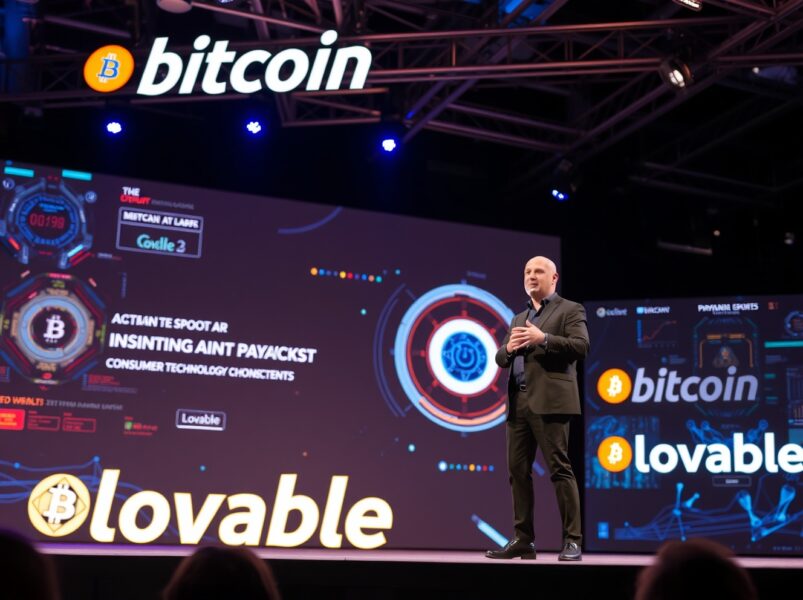
Lovable AI’s Astonishing Rise: Anton Osika Reveals Startup Secrets at Bitcoin World Disrupt 2025

Lovable AI’s Astonishing Rise: Anton Osika Reveals Startup Secrets at Bitcoin World Disrupt 2025

BitcoinWorld Lovable AI’s Astonishing Rise: Anton Osika Reveals Startup Secrets at Bitcoin World Disrupt 2025 Are you ready to witness a phenomenon? The world of technology is abuzz with the incredible rise of Lovable AI, a startup that’s not just breaking records but rewriting the rulebook for rapid growth. Imagine creating powerful apps and websites just by speaking to an AI – that’s the magic Lovable brings to the masses. This groundbreaking approach has propelled the company into the spotlight, making it one of the fastest-growing software firms in history. And now, the visionary behind this sensation, co-founder and CEO Anton Osika, is set to share his invaluable insights on the Disrupt Stage at the highly anticipated Bitcoin World Disrupt 2025. If you’re a founder, investor, or tech enthusiast eager to understand the future of innovation, this is an event you cannot afford to miss. Lovable AI’s Meteoric Ascent: Redefining Software Creation In an era where digital transformation is paramount, Lovable AI has emerged as a true game-changer. Its core premise is deceptively simple yet profoundly impactful: democratize software creation. By enabling anyone to build applications and websites through intuitive AI conversations, Lovable is empowering the vast majority of individuals who lack coding skills to transform their ideas into tangible digital products. This mission has resonated globally, leading to unprecedented momentum. The numbers speak for themselves: Achieved an astonishing $100 million Annual Recurring Revenue (ARR) in less than a year. Successfully raised a $200 million Series A funding round, valuing the company at $1.8 billion, led by industry giant Accel. Is currently fielding unsolicited investor offers, pushing its valuation towards an incredible $4 billion. As industry reports suggest, investors are unequivocally “loving Lovable,” and it’s clear why. This isn’t just about impressive financial metrics; it’s about a company that has tapped into a fundamental need, offering a solution that is both innovative and accessible. The rapid scaling of Lovable AI provides a compelling case study for any entrepreneur aiming for similar exponential growth. The Visionary Behind the Hype: Anton Osika’s Journey to Innovation Every groundbreaking company has a driving force, and for Lovable, that force is co-founder and CEO Anton Osika. His journey is as fascinating as his company’s success. A physicist by training, Osika previously contributed to the cutting-edge research at CERN, the European Organization for Nuclear Research. This deep technical background, combined with his entrepreneurial spirit, has been instrumental in Lovable’s rapid ascent. Before Lovable, he honed his skills as a co-founder of Depict.ai and a Founding Engineer at Sana. Based in Stockholm, Osika has masterfully steered Lovable from a nascent idea to a global phenomenon in record time. His leadership embodies a unique blend of profound technical understanding and a keen, consumer-first vision. At Bitcoin World Disrupt 2025, attendees will have the rare opportunity to hear directly from Osika about what it truly takes to build a brand that not only scales at an incredible pace in a fiercely competitive market but also adeptly manages the intense cultural conversations that inevitably accompany such swift and significant success. His insights will be crucial for anyone looking to understand the dynamics of high-growth tech leadership. Unpacking Consumer Tech Innovation at Bitcoin World Disrupt 2025 The 20th anniversary of Bitcoin World is set to be marked by a truly special event: Bitcoin World Disrupt 2025. From October 27–29, Moscone West in San Francisco will transform into the epicenter of innovation, gathering over 10,000 founders, investors, and tech leaders. It’s the ideal platform to explore the future of consumer tech innovation, and Anton Osika’s presence on the Disrupt Stage is a highlight. His session will delve into how Lovable is not just participating in but actively shaping the next wave of consumer-facing technologies. Why is this session particularly relevant for those interested in the future of consumer experiences? Osika’s discussion will go beyond the superficial, offering a deep dive into the strategies that have allowed Lovable to carve out a unique category in a market long thought to be saturated. Attendees will gain a front-row seat to understanding how to identify unmet consumer needs, leverage advanced AI to meet those needs, and build a product that captivates users globally. The event itself promises a rich tapestry of ideas and networking opportunities: For Founders: Sharpen your pitch and connect with potential investors. For Investors: Discover the next breakout startup poised for massive growth. For Innovators: Claim your spot at the forefront of technological advancements. The insights shared regarding consumer tech innovation at this event will be invaluable for anyone looking to navigate the complexities and capitalize on the opportunities within this dynamic sector. Mastering Startup Growth Strategies: A Blueprint for the Future Lovable’s journey isn’t just another startup success story; it’s a meticulously crafted blueprint for effective startup growth strategies in the modern era. Anton Osika’s experience offers a rare glimpse into the practicalities of scaling a business at breakneck speed while maintaining product integrity and managing external pressures. For entrepreneurs and aspiring tech leaders, his talk will serve as a masterclass in several critical areas: Strategy Focus Key Takeaways from Lovable’s Journey Rapid Scaling How to build infrastructure and teams that support exponential user and revenue growth without compromising quality. Product-Market Fit Identifying a significant, underserved market (the 99% who can’t code) and developing a truly innovative solution (AI-powered app creation). Investor Relations Balancing intense investor interest and pressure with a steadfast focus on product development and long-term vision. Category Creation Carving out an entirely new niche by democratizing complex technologies, rather than competing in existing crowded markets. Understanding these startup growth strategies is essential for anyone aiming to build a resilient and impactful consumer experience. Osika’s session will provide actionable insights into how to replicate elements of Lovable’s success, offering guidance on navigating challenges from product development to market penetration and investor management. Conclusion: Seize the Future of Tech The story of Lovable, under the astute leadership of Anton Osika, is a testament to the power of innovative ideas meeting flawless execution. Their remarkable journey from concept to a multi-billion-dollar valuation in record time is a compelling narrative for anyone interested in the future of technology. By democratizing software creation through Lovable AI, they are not just building a company; they are fostering a new generation of creators. His appearance at Bitcoin World Disrupt 2025 is an unmissable opportunity to gain direct insights from a leader who is truly shaping the landscape of consumer tech innovation. Don’t miss this chance to learn about cutting-edge startup growth strategies and secure your front-row seat to the future. Register now and save up to $668 before Regular Bird rates end on September 26. To learn more about the latest AI market trends, explore our article on key developments shaping AI features. This post Lovable AI’s Astonishing Rise: Anton Osika Reveals Startup Secrets at Bitcoin World Disrupt 2025 first appeared on BitcoinWorld.
Share
Coinstats2025/09/17 23:40