The post Malicious worm compromises crypto domains in supply-chain attack appeared on BitcoinEthereumNews.com. On Nov. 24, security firm Aikido detected a second wave of the Shai-Hulud self-replicating npm worm, compromising 492 packages with a combined 132 million monthly downloads. The attack struck major ecosystems, including AsyncAPI, PostHog, Postman, Zapier, and ENS, exploiting the final weeks before npm’s Dec. 9 deadline to revoke legacy authentication tokens. Aikido’s triage queue flagged the intrusion around 3:16 AM UTC, as malicious versions of AsyncAPI’s go-template and 36 related packages began spreading across the registry. The attacker labeled stolen-credential repositories with the description “Sha1-Hulud: The Second Coming,” maintaining theatrical branding from the September campaign. The worm installs the Bun runtime during package setup, then executes malicious code that searches developer environments for exposed secrets using TruffleHog. Compromised API keys, GitHub tokens, and npm credentials are published to randomly named public repositories, and the malware attempts to propagate by pushing new infected versions to up to 100 additional packages, five times the scale of the September attack. Technical evolution and destructive payload The November iteration introduces several modifications from the September attack.The malware now creates repositories with randomly generated names for stolen data rather than using hardcoded names, complicating takedown efforts. Setup code installs Bun via setup_bun.js before executing the primary payload in bun_environment.js, which contains the worm logic and credential-exfiltration routines. The most destructive addition: if the malware cannot authenticate with GitHub or npm using stolen credentials, it wipes all files in the user’s home directory. Aikido’s analysis revealed execution errors that limited the attack’s spread. The bundling code that copies the full worm into new packages sometimes fails to include bun_environment.js, leaving only the Bun installation script without the malicious payload. Despite these failures, the initial compromises hit high-value targets with massive downstream exposure. AsyncAPI packages dominated the first wave, with 36 compromised releases including @asyncapi/cli, @asyncapi/parser,… The post Malicious worm compromises crypto domains in supply-chain attack appeared on BitcoinEthereumNews.com. On Nov. 24, security firm Aikido detected a second wave of the Shai-Hulud self-replicating npm worm, compromising 492 packages with a combined 132 million monthly downloads. The attack struck major ecosystems, including AsyncAPI, PostHog, Postman, Zapier, and ENS, exploiting the final weeks before npm’s Dec. 9 deadline to revoke legacy authentication tokens. Aikido’s triage queue flagged the intrusion around 3:16 AM UTC, as malicious versions of AsyncAPI’s go-template and 36 related packages began spreading across the registry. The attacker labeled stolen-credential repositories with the description “Sha1-Hulud: The Second Coming,” maintaining theatrical branding from the September campaign. The worm installs the Bun runtime during package setup, then executes malicious code that searches developer environments for exposed secrets using TruffleHog. Compromised API keys, GitHub tokens, and npm credentials are published to randomly named public repositories, and the malware attempts to propagate by pushing new infected versions to up to 100 additional packages, five times the scale of the September attack. Technical evolution and destructive payload The November iteration introduces several modifications from the September attack.The malware now creates repositories with randomly generated names for stolen data rather than using hardcoded names, complicating takedown efforts. Setup code installs Bun via setup_bun.js before executing the primary payload in bun_environment.js, which contains the worm logic and credential-exfiltration routines. The most destructive addition: if the malware cannot authenticate with GitHub or npm using stolen credentials, it wipes all files in the user’s home directory. Aikido’s analysis revealed execution errors that limited the attack’s spread. The bundling code that copies the full worm into new packages sometimes fails to include bun_environment.js, leaving only the Bun installation script without the malicious payload. Despite these failures, the initial compromises hit high-value targets with massive downstream exposure. AsyncAPI packages dominated the first wave, with 36 compromised releases including @asyncapi/cli, @asyncapi/parser,…

Malicious worm compromises crypto domains in supply-chain attack

On Nov. 24, security firm Aikido detected a second wave of the Shai-Hulud self-replicating npm worm, compromising 492 packages with a combined 132 million monthly downloads.

The attack struck major ecosystems, including AsyncAPI, PostHog, Postman, Zapier, and ENS, exploiting the final weeks before npm’s Dec. 9 deadline to revoke legacy authentication tokens.

Aikido’s triage queue flagged the intrusion around 3:16 AM UTC, as malicious versions of AsyncAPI’s go-template and 36 related packages began spreading across the registry.

The attacker labeled stolen-credential repositories with the description “Sha1-Hulud: The Second Coming,” maintaining theatrical branding from the September campaign.

The worm installs the Bun runtime during package setup, then executes malicious code that searches developer environments for exposed secrets using TruffleHog.

Compromised API keys, GitHub tokens, and npm credentials are published to randomly named public repositories, and the malware attempts to propagate by pushing new infected versions to up to 100 additional packages, five times the scale of the September attack.

Technical evolution and destructive payload

The November iteration introduces several modifications from the September attack.
The malware now creates repositories with randomly generated names for stolen data rather than using hardcoded names, complicating takedown efforts.

Setup code installs Bun via setup_bun.js before executing the primary payload in bun_environment.js, which contains the worm logic and credential-exfiltration routines.

The most destructive addition: if the malware cannot authenticate with GitHub or npm using stolen credentials, it wipes all files in the user’s home directory.

Aikido’s analysis revealed execution errors that limited the attack’s spread. The bundling code that copies the full worm into new packages sometimes fails to include bun_environment.js, leaving only the Bun installation script without the malicious payload.

Despite these failures, the initial compromises hit high-value targets with massive downstream exposure.

AsyncAPI packages dominated the first wave, with 36 compromised releases including @asyncapi/cli, @asyncapi/parser, and @asyncapi/generator.

PostHog followed at 4:11 AM UTC, with infected versions of posthog-js, posthog-node, and dozens of plugins. Postman packages arrived at 5:09 AM UTC.

The Zapier compromise affected @zapier/zapier-sdk, zapier-platform-cli, and zapier-platform-core, while the ENS compromise affected @ensdomains/ensjs, @ensdomains/ens-contracts, and ethereum-ens.

GitHub branch creation suggests repository-level access

The AsyncAPI team discovered a malicious branch in their CLI repository created immediately before the compromised packages appeared on npm.

The branch contained a deployed version of the Shai-Hulud malware, indicating the attacker gained write access to the repository itself rather than simply hijacking npm tokens.

This escalation mirrors the technique used in the original Nx compromise, in which attackers modified source repositories to inject malicious code into legitimate build pipelines.

Aikido estimates that 26,300 GitHub repositories now contain stolen credentials marked with the “Sha1-Hulud: The Second Coming” description.

The repositories contain secrets exposed by developer environments that ran the compromised packages, including cloud service credentials, CI/CD tokens, and authentication keys for third-party APIs.

The public nature of the leaks amplifies the damage: any attacker monitoring the repositories can harvest credentials in real time and launch secondary attacks.

Attack timing and mitigation

The timing coincides with npm’s Nov. 15 announcement that it will revoke classic authentication tokens on Dec. 9.

The attacker’s choice to launch a final large-scale campaign before the deadline suggests they recognized the window for token-based compromises was closing. Aikido’s timeline shows the first Shai-Hulud wave began Sept. 16.

The Nov. 24 “Second Coming” represents the attacker’s last opportunity to exploit legacy tokens before npm’s migration cuts off that access.

Aikido recommends that security teams audit all dependencies from affected ecosystems, particularly the Zapier, ENS, AsyncAPI, PostHog, and Postman packages installed or updated after Nov. 24.

Organizations should rotate all GitHub, npm, cloud, and CI/CD secrets used in environments where these packages were present, and search GitHub for repositories with the “Sha1-Hulud: The Second Coming” description to determine if internal credentials were exposed.

Disabling npm postinstall scripts in CI pipelines prevents future install-time execution, and pinning package versions with lock files limits exposure to newly compromised releases.

Source: https://cryptoslate.com/malicious-worm-compromises-crypto-domains-in-supply-chain-attack/

Market Opportunity
Major Logo
Major Price(MAJOR)
$0.1181
$0.1181$0.1181
-5.80%
USD
Major (MAJOR) Live Price Chart
Disclaimer: The articles reposted on this site are sourced from public platforms and are provided for informational purposes only. They do not necessarily reflect the views of MEXC. All rights remain with the original authors. If you believe any content infringes on third-party rights, please contact [email protected] for removal. MEXC makes no guarantees regarding the accuracy, completeness, or timeliness of the content and is not responsible for any actions taken based on the information provided. The content does not constitute financial, legal, or other professional advice, nor should it be considered a recommendation or endorsement by MEXC.

You May Also Like

Report: Galaxy to Launch $100 Million Crypto Hedge Fund in Q1

Report: Galaxy to Launch $100 Million Crypto Hedge Fund in Q1

The post Report: Galaxy to Launch $100 Million Crypto Hedge Fund in Q1 appeared on BitcoinEthereumNews.com. Galaxy is launching a $100 million hedge fund to trade
Share
BitcoinEthereumNews2026/01/21 19:49
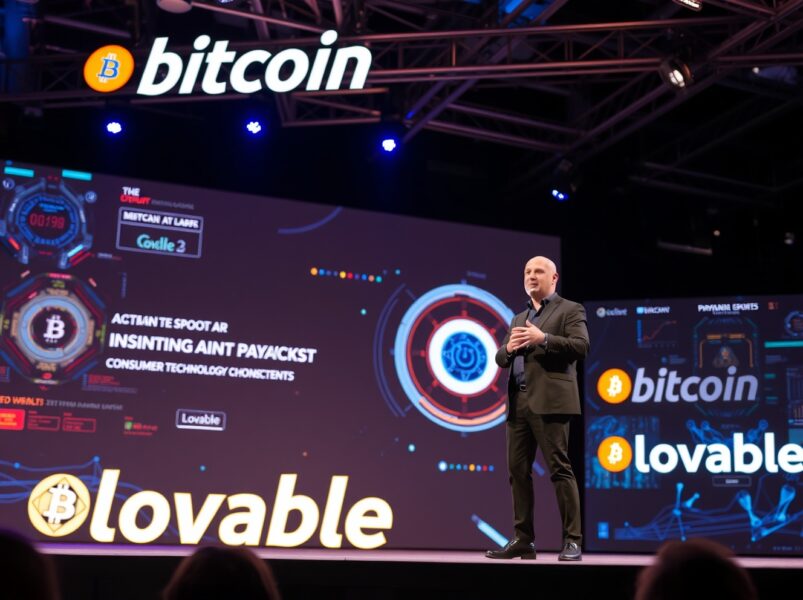
Lovable AI’s Astonishing Rise: Anton Osika Reveals Startup Secrets at Bitcoin World Disrupt 2025

Lovable AI’s Astonishing Rise: Anton Osika Reveals Startup Secrets at Bitcoin World Disrupt 2025

BitcoinWorld Lovable AI’s Astonishing Rise: Anton Osika Reveals Startup Secrets at Bitcoin World Disrupt 2025 Are you ready to witness a phenomenon? The world of technology is abuzz with the incredible rise of Lovable AI, a startup that’s not just breaking records but rewriting the rulebook for rapid growth. Imagine creating powerful apps and websites just by speaking to an AI – that’s the magic Lovable brings to the masses. This groundbreaking approach has propelled the company into the spotlight, making it one of the fastest-growing software firms in history. And now, the visionary behind this sensation, co-founder and CEO Anton Osika, is set to share his invaluable insights on the Disrupt Stage at the highly anticipated Bitcoin World Disrupt 2025. If you’re a founder, investor, or tech enthusiast eager to understand the future of innovation, this is an event you cannot afford to miss. Lovable AI’s Meteoric Ascent: Redefining Software Creation In an era where digital transformation is paramount, Lovable AI has emerged as a true game-changer. Its core premise is deceptively simple yet profoundly impactful: democratize software creation. By enabling anyone to build applications and websites through intuitive AI conversations, Lovable is empowering the vast majority of individuals who lack coding skills to transform their ideas into tangible digital products. This mission has resonated globally, leading to unprecedented momentum. The numbers speak for themselves: Achieved an astonishing $100 million Annual Recurring Revenue (ARR) in less than a year. Successfully raised a $200 million Series A funding round, valuing the company at $1.8 billion, led by industry giant Accel. Is currently fielding unsolicited investor offers, pushing its valuation towards an incredible $4 billion. As industry reports suggest, investors are unequivocally “loving Lovable,” and it’s clear why. This isn’t just about impressive financial metrics; it’s about a company that has tapped into a fundamental need, offering a solution that is both innovative and accessible. The rapid scaling of Lovable AI provides a compelling case study for any entrepreneur aiming for similar exponential growth. The Visionary Behind the Hype: Anton Osika’s Journey to Innovation Every groundbreaking company has a driving force, and for Lovable, that force is co-founder and CEO Anton Osika. His journey is as fascinating as his company’s success. A physicist by training, Osika previously contributed to the cutting-edge research at CERN, the European Organization for Nuclear Research. This deep technical background, combined with his entrepreneurial spirit, has been instrumental in Lovable’s rapid ascent. Before Lovable, he honed his skills as a co-founder of Depict.ai and a Founding Engineer at Sana. Based in Stockholm, Osika has masterfully steered Lovable from a nascent idea to a global phenomenon in record time. His leadership embodies a unique blend of profound technical understanding and a keen, consumer-first vision. At Bitcoin World Disrupt 2025, attendees will have the rare opportunity to hear directly from Osika about what it truly takes to build a brand that not only scales at an incredible pace in a fiercely competitive market but also adeptly manages the intense cultural conversations that inevitably accompany such swift and significant success. His insights will be crucial for anyone looking to understand the dynamics of high-growth tech leadership. Unpacking Consumer Tech Innovation at Bitcoin World Disrupt 2025 The 20th anniversary of Bitcoin World is set to be marked by a truly special event: Bitcoin World Disrupt 2025. From October 27–29, Moscone West in San Francisco will transform into the epicenter of innovation, gathering over 10,000 founders, investors, and tech leaders. It’s the ideal platform to explore the future of consumer tech innovation, and Anton Osika’s presence on the Disrupt Stage is a highlight. His session will delve into how Lovable is not just participating in but actively shaping the next wave of consumer-facing technologies. Why is this session particularly relevant for those interested in the future of consumer experiences? Osika’s discussion will go beyond the superficial, offering a deep dive into the strategies that have allowed Lovable to carve out a unique category in a market long thought to be saturated. Attendees will gain a front-row seat to understanding how to identify unmet consumer needs, leverage advanced AI to meet those needs, and build a product that captivates users globally. The event itself promises a rich tapestry of ideas and networking opportunities: For Founders: Sharpen your pitch and connect with potential investors. For Investors: Discover the next breakout startup poised for massive growth. For Innovators: Claim your spot at the forefront of technological advancements. The insights shared regarding consumer tech innovation at this event will be invaluable for anyone looking to navigate the complexities and capitalize on the opportunities within this dynamic sector. Mastering Startup Growth Strategies: A Blueprint for the Future Lovable’s journey isn’t just another startup success story; it’s a meticulously crafted blueprint for effective startup growth strategies in the modern era. Anton Osika’s experience offers a rare glimpse into the practicalities of scaling a business at breakneck speed while maintaining product integrity and managing external pressures. For entrepreneurs and aspiring tech leaders, his talk will serve as a masterclass in several critical areas: Strategy Focus Key Takeaways from Lovable’s Journey Rapid Scaling How to build infrastructure and teams that support exponential user and revenue growth without compromising quality. Product-Market Fit Identifying a significant, underserved market (the 99% who can’t code) and developing a truly innovative solution (AI-powered app creation). Investor Relations Balancing intense investor interest and pressure with a steadfast focus on product development and long-term vision. Category Creation Carving out an entirely new niche by democratizing complex technologies, rather than competing in existing crowded markets. Understanding these startup growth strategies is essential for anyone aiming to build a resilient and impactful consumer experience. Osika’s session will provide actionable insights into how to replicate elements of Lovable’s success, offering guidance on navigating challenges from product development to market penetration and investor management. Conclusion: Seize the Future of Tech The story of Lovable, under the astute leadership of Anton Osika, is a testament to the power of innovative ideas meeting flawless execution. Their remarkable journey from concept to a multi-billion-dollar valuation in record time is a compelling narrative for anyone interested in the future of technology. By democratizing software creation through Lovable AI, they are not just building a company; they are fostering a new generation of creators. His appearance at Bitcoin World Disrupt 2025 is an unmissable opportunity to gain direct insights from a leader who is truly shaping the landscape of consumer tech innovation. Don’t miss this chance to learn about cutting-edge startup growth strategies and secure your front-row seat to the future. Register now and save up to $668 before Regular Bird rates end on September 26. To learn more about the latest AI market trends, explore our article on key developments shaping AI features. This post Lovable AI’s Astonishing Rise: Anton Osika Reveals Startup Secrets at Bitcoin World Disrupt 2025 first appeared on BitcoinWorld.
Share
Coinstats2025/09/17 23:40
RezorEx launch tests Rezor’s execution in crowded exchange market

RezorEx launch tests Rezor’s execution in crowded exchange market

Rezor launches RezorEx, a centralized crypto exchange built alongside its wallet and cross-chain aggregator, framing the platform as a proof of execution, not hype
Share
Crypto.news2026/01/21 20:09