

Can JustLend DAO’s buyback program pull JST out of its downtrend?
JustLend DAO, a decentralized lending platform on Tron, has kicked off its JST Buyback & Burn Program with a 559.9 million token burn, sparking hopes of a trend reversal.
- The DAO used 30% of its $59.15 million revenue (≈17.73M USDT) to repurchase and burn 559.89M JST, about 5.66% of the total supply.
- The remaining 70% of revenue (41.42M USDT) will fund future quarterly buybacks through Q4 2026, with proceeds allocated to JustLend’s SBM > USDT market.
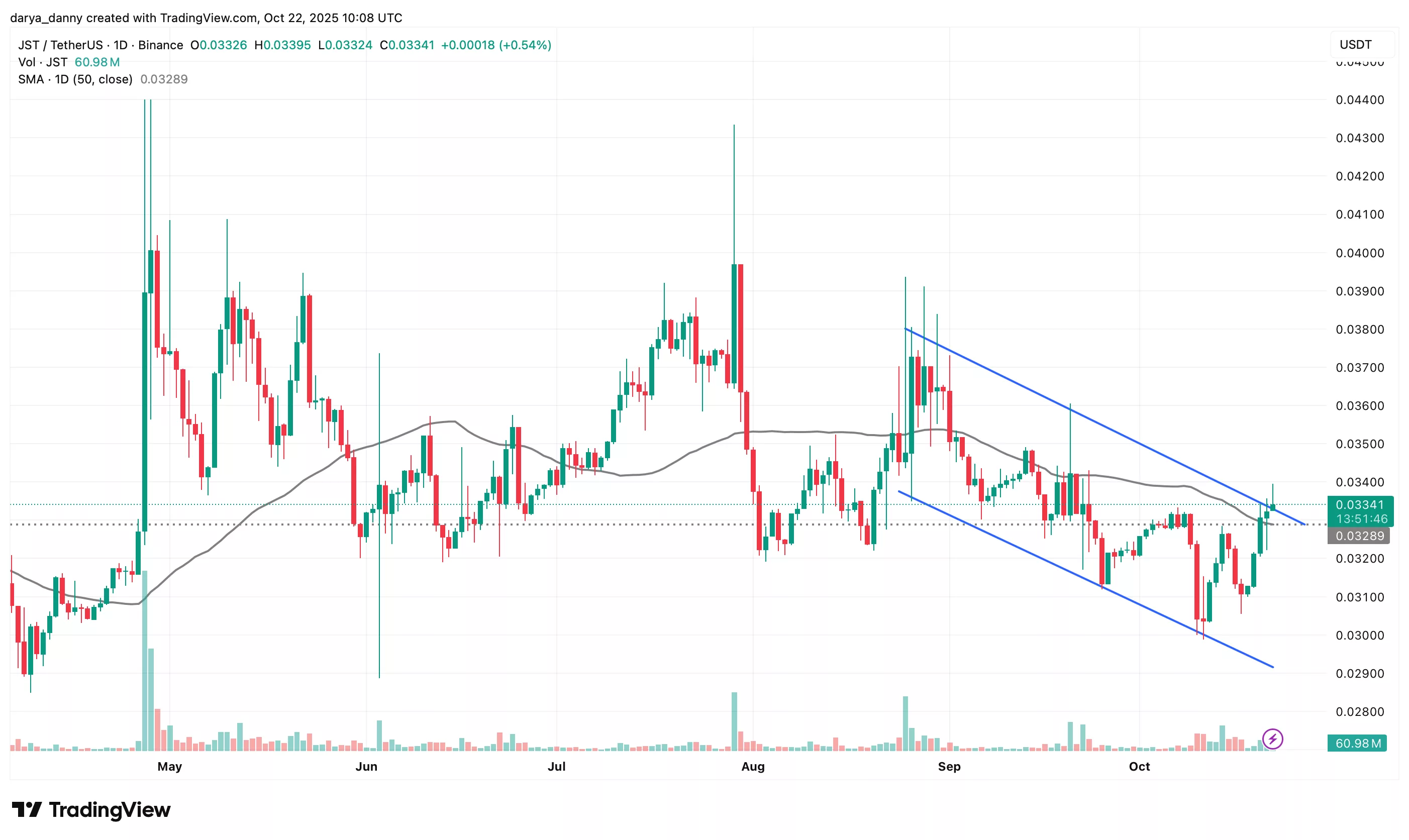
- Technically, JST price is testing breakout resistance near $0.034, with a confirmed close above $0.035 potentially setting up a +25% move toward $0.043.
On October 21, JustLend DAO, a decentralized lending platform on Tron (TRX), officially implemented its JST Buyback & Burn Program, using part of its revenue to reduce token supply. The initial burn utilized 30% of existing revenue, totaling 17.73 million USDT, to repurchase and burn 559.89 million JST — approximately 5.66% of the total supply. The transaction was executed transparently on-chain.
The remaining revenue, 41.42 million USDT, has been allocated to JustLend’s SBM > USDT market, with future yields earmarked for additional buybacks. Moving forward, JustLend DAO plans quarterly buybacks and burns, gradually using the remaining 70% of existing revenue over four quarters through Q4 2026.
JST price may be on the cusp of reversal
The buybacks and burns might be just what the JST token needs, as it has been trading in a steady downtrend for months. The price attempted but failed to reverse from a double-bottom pattern in mid-August and subsequently slipped into a descending channel.
However, JST price is showing the first signs of reversal, having bounced from the channel’s lower trendline, pulled back, and then formed its first higher low. It’s now testing the descending trendline resistance near the $0.034 level.
If JST price can close and hold above $0.0345–$0.0350, the next upside target from this breakout pattern would be $0.043, representing roughly a +25% measured move from the breakout zone.
You May Also Like

‘European SEC’ proposal sparks licensing concerns, institutional ambitions
Legal experts are concerned that transforming ESMA into the “European SEC” may hinder the licensing of crypto and fintech in the region. The European Commission’s proposal to expand the powers of the European Securities and Markets Authority (ESMA) is raising concerns about the centralization of the bloc’s licensing regime, despite signaling deeper institutional ambitions for its capital markets structure.On Thursday, the Commission published a package proposing to “direct supervisory competences” for key pieces of market infrastructure, including crypto-asset service providers (CASPs), trading venues and central counterparties to ESMA, Cointelegraph reported.Concerningly, the ESMA’s jurisdiction would extend to both the supervision and licensing of all European crypto and financial technology (fintech) firms, potentially leading to slower licensing regimes and hindering startup development, according to Faustine Fleuret, head of public affairs at decentralized lending protocol Morpho.Read more

BlackRock boosts AI and US equity exposure in $185 billion models

