

Must Read
Will President Marcos will look at the economic prognosis honestly and take it seriously, or just bank on more spin?Will President Marcos will look at the economic prognosis honestly and take it seriously, or just bank on more spin?
[In This Economy] Fitch’s warning shot: Reading the negative outlook
For feedback or concerns regarding this content, please contact us at [email protected]
Last Monday, April 20, Fitch Ratings revised its outlook on the Philippines from “stable” to “negative,” while keeping our long-term credit rating at “BBB.”
The Palace was quick to argue that this is “not a downgrade.” Technically, that is correct. But it is also beside the point.
It’s best to view the negative outlook as a warning shot. It tells the world that, within the next 18 to 24 months, there is a meaningful chance our credit rating will actually be cut.
If that happens, it would be the first time we get downgraded by Fitch since 2005, more than two decades ago. Hence, the headlines about a possible “first downgrade in decades.”
Some commentators are calling the negative outlook itself a once-in-a-generation event. It really isn’t. Fitch already put us on a negative outlook in July 2021, after the pandemic blew a hole in our public finances. They eventually restored it to “stable” in May 2023. What would be unprecedented in a long time is an actual downgrade, not the warning.
What did Fitch see?
Fitch’s press release is blunt about three things.
First, they rightly noted that public investment has stalled. Growth slowed sharply in 2025 to 4.4%, from 5.7% in 2024, largely because the government’s investment spending fell off a cliff in the second half of 2025.
As I wrote in this column before, the flood control corruption scandal of 2025 scared agencies into freezing disbursements. Fitch now expects overall growth of just 4.6% in 2026.
Put simply, we are not just losing a few decimal points of GDP. Growth is stalling significantly, even before the US–Iran war broke out.
Second, Fitch noted that we are especially exposed to the energy shock from the Middle East conflict. After all, the government has had to declare a National Energy Emergency, push for fuel conservation, and pay targeted subsidies. In addition, Fitch now expects inflation to jump from 1.7% in 2025 to 4.1% in 2026, with the current account deficit widening to 3.8% of GDP (a current account deficit means we spend more on the world than we earn from the rest of the world).
None of this is the administration’s fault, in the sense that nobody in Malacañang sets world oil prices. We are a small open economy, so we are a “price taker” (not a price maker) in the global oil market. But it does mean we are absorbing the shock with weaker buffers than we had before.
Third, our external position is quietly eroding. Fitch noted, almost in passing, that the Philippines will become a net borrower in 2026. This is nothing new: we have been running current account deficits since 2021. Having such a deficit is not disastrous per se, but it does chip away at our buffers.
What is most damning is buried in the technical section. Fitch’s own model gives the Philippines a score equivalent to “BB+” or two notches below BBB, and below investment grade. The reason we sit at BBB is that Fitch’s committee added a discretionary “+2 notches” on top of the model. One of those notches is precisely for “strong and sustained” medium-term growth and “a sound policy framework.” The negative outlook is Fitch saying that extra notch is now under review.
In short, if we’re going to be strict about it, we already should’ve had a credit rating downgrade. But Fitch pulled its punches.
The Palace’s response
Predictably, the response from the Marcos administration has been a mix of denial and deflection. Officials have pointed out, correctly, that BBB is still investment grade, that other credit rating agencies have not moved, and that Fitch did affirm the rating.
Some people have tried to attribute everything to the energy shock, as if the rest of the world is in the same boat.
Unfortunately, this is selective reading. Fitch did not just talk about energy. It explicitly named the slowdown in public investment, the corruption probes around flood control, the volatility of domestic politics, and the economy’s weaker external position. The energy shock is the cyclical worry, but the investment slowdown and governance issues are the domestic, structural worry. The latter is what should keep economic managers awake at night.
The truth is, corruption raises costs, scares investors, distorts budgets, and weakens services. All that eventually shows up in the credit rating.
It is also disingenuous to wave away politics. Fitch devoted a paragraph to the deepening rift between Marcos and Vice President Sara Duterte, the renewed impeachment process against Duterte, and the ongoing investigations into misallocated public funds. Ratings analysts do not usually wade into local politics just for fun. They do so because, in their estimation, it is starting to color how they read economic policymaking.
Why this matters
If the country’s credit rating does deteriorate, it means the government (and every Filipino bank or company that borrows abroad) will have to pay higher interest. That interest comes from the same pot of taxes that funds classrooms, health centers, and financial assistance for the poor. It also undercuts even more the country’s pitch as a “darling of investors.” Attracting more foreign capital will be a lot more difficult.
Fitch is quite specific about what would tilt us toward a downgrade and what would push us back to stable. To avoid a downgrade, the government has to do three things at once: restore public investment without burying the corruption probes, keep fiscal consolidation on track even as election-year pressures push the other way, and stop the current account deficit from drifting further.
To get back to a “stable” outlook, we also need visible progress on the governance front: much cleaner procurement, prosecution of the flood control cases, and proof that policy will not be hijacked by the next political fight.
None of this is impossible. But it requires the Marcos administration to stop treating the negative outlook as a mere PR problem and start treating it as the symptom of a real one.
After 2021, the last time Fitch gave us a negative outlook, it took two years of coordinated work to get back to stable. We do not have that luxury this time, because an energy shock, a corruption crisis, and the looming 2028 polls are happening all at once.
A negative outlook is not yet a downgrade, and Fitch has handed the government a fairly detailed checklist to avoid one. The question is whether President Marcos will look at the economic prognosis honestly and take it seriously, or just bank on more spin. – Rappler.com
Dr. JC Punongbayan is an assistant professor at the UP School of Economics and the author of False Nostalgia: The Marcos “Golden Age” Myths and How to Debunk Them. In 2024, he received The Outstanding Young Men (TOYM) Award for economics. Follow him on Instagram (@jcpunongbayan).
Click here for more In This Economy articles.
Market Opportunity
Overtake Price(TAKE)
$0.03082
$0.03082$0.03082
USD
Overtake (TAKE) Live Price Chart


Disclaimer: The articles reposted on this site are sourced from public platforms and are provided for informational purposes only. They do not necessarily reflect the views of MEXC. All rights remain with the original authors. If you believe any content infringes on third-party rights, please contact [email protected] for removal. MEXC makes no guarantees regarding the accuracy, completeness, or timeliness of the content and is not responsible for any actions taken based on the information provided. The content does not constitute financial, legal, or other professional advice, nor should it be considered a recommendation or endorsement by MEXC.
You May Also Like
India Gold Price Today Plunges: Bitcoin World Data Reveals Sharp Decline
BitcoinWorld India Gold Price Today Plunges: Bitcoin World Data Reveals Sharp Decline India gold price today has fallen sharply, according to the latest data from
Share
bitcoinworld2026/04/24 14:05

U.S. Soldier Charged for Insider Trading on Polymarket, Made $409K Profit
The post U.S. Soldier Charged for Insider Trading on Polymarket, Made $409K Profit appeared first on Coinpedia Fintech News A U.S. Army soldier has been charged
Share
CoinPedia2026/04/24 13:54
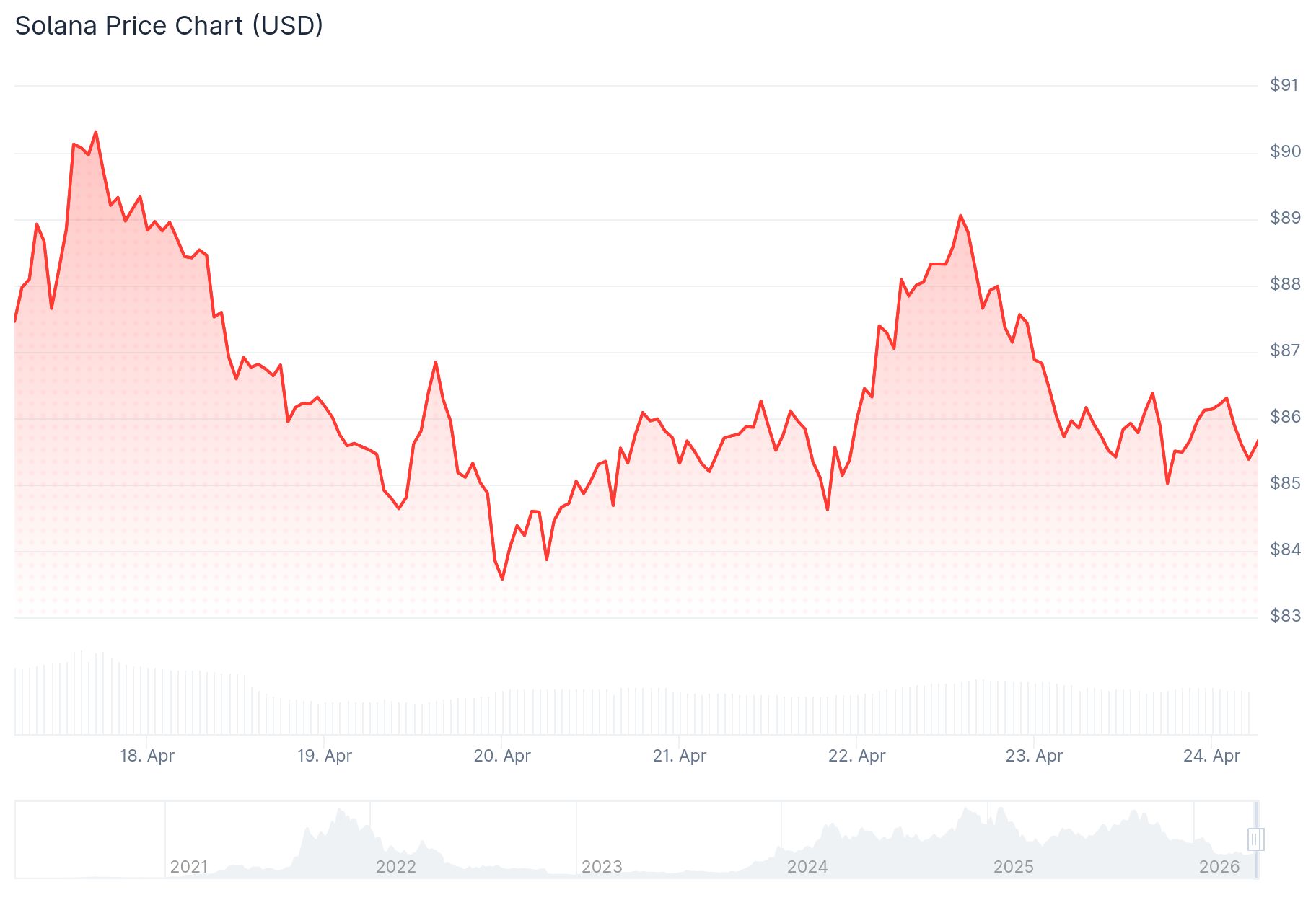
Solana (SOL) Price: Institutions Pour Into SOL as Charts Set Up for a Possible Breakout
TLDR SOL trades at $85.95, held just above the 20-day EMA at $85.31, with the 50-day EMA at $87.08 acting as resistance since March. SOL has broken above a long
Share
Coincentral2026/04/24 14:20



