South Korea made history this week by launching its first Korean won-backed stablecoin.South Korea made history this week by launching its first Korean won-backed stablecoin.

South Korea Launches First Won-Backed Stablecoin KRW1 on Avalanche

2025/09/19 03:15
South Korea Launches First Won-Backed Stablecoin KRW1 on Avalanche

The digital currency, called KRW1, runs on the Avalanche blockchain and marks a major step forward for the country’s digital finance sector.

BDACS, a South Korean crypto custody firm, announced the launch after successfully completing technical testing with Woori Bank, one of the country’s largest financial institutions. Each KRW1 token is backed by actual Korean won held safely at the bank.

The launch comes at a time when South Korea lacks clear rules for stablecoins. However, the government is working on new laws that could change this soon.

What Makes KRW1 Different

KRW1 stands out because it connects traditional banking with modern blockchain technology. Every digital token is backed 1:1 by Korean won stored at Woori Bank. This means users can trust that their digital money has real value behind it.

The stablecoin uses real-time banking connections to prove its reserves exist. This transparency helps build trust between users and the platform. Harry Ryoo, CEO of BDACS, said his company is “building the backbone of the digital asset market, serving corporate, institutional, and public-sector partners.”
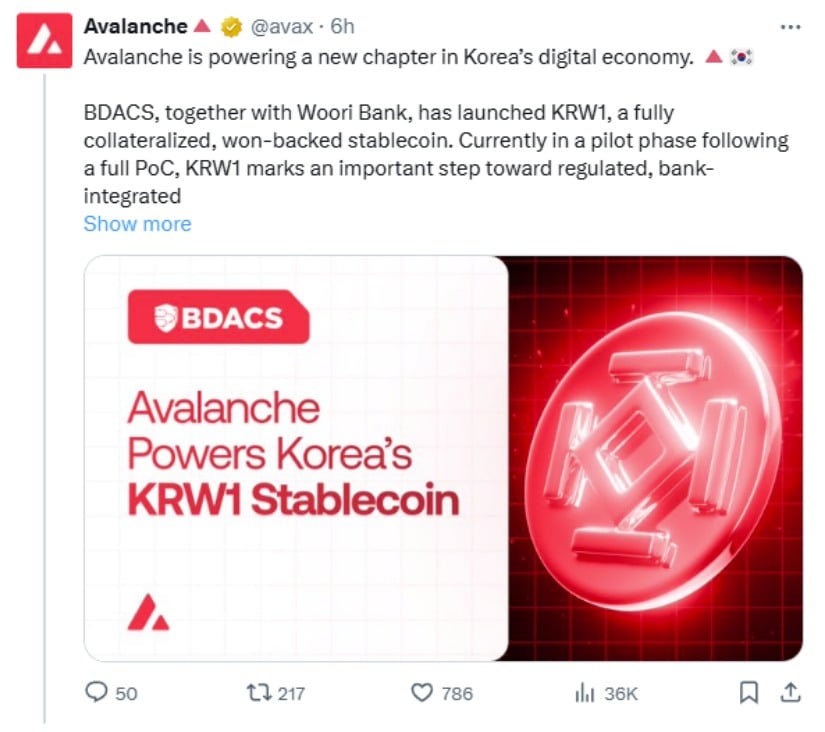
@avax

Source: @avax

BDACS chose Avalanche for its speed and security. The Korea Internet & Security Agency has recognized Avalanche as reliable for public sector use. Justin Kim, Head of Asia at Ava Labs, noted that KRW1 shows “the need for a highly-performant and reliable blockchain tailored for a regulatory-compliant stablecoin.”

Government and Public Sector Plans

KRW1 was designed with government use in mind. BDACS plans to offer it as a low-cost payment system for public programs. This could significantly reduce fees when the government distributes emergency relief money or processes other payments.

The company has already built systems for issuing tokens, managing reserves, and verifying transactions. They also created a user app that lets people send money to each other and check transaction details.

Currently, KRW1 operates as a proof-of-concept project. This means it’s not available to the general public yet. This careful approach helps the company avoid breaking any current laws while they wait for new regulations.

Regulatory Landscape Taking Shape

South Korea’s government is moving quickly to create rules for digital currencies. President Lee Jae-myung has promised to support won-backed stablecoins as part of his plan to strengthen the country’s financial independence.

The ruling Democratic Party proposed the Digital Asset Basic Act, which would allow Korean companies to issue stablecoins. Companies would need at least 500 million won (about $368,000) in capital and must keep enough reserves to guarantee refunds.

The Financial Services Commission plans to submit a government bill to lawmakers in October 2025. This new law would create the country’s first official framework for stablecoins.

However, recent political events have slowed progress. The National Assembly postponed discussions about virtual asset rules until at least 2025 following martial law declarations and impeachment proceedings.

Market Competition Heating Up

BDACS isn’t the only company preparing for South Korea’s stablecoin future. At least three major banks – Kakao Bank, Kookmin Bank, and Industrial Bank of Korea – have filed trademark applications for their own Korean won stablecoins.

This competition shows how seriously financial institutions take the stablecoin opportunity. South Korea has one of the world’s most active crypto markets, with over 18 million people – more than one-third of the population – involved in digital assets.

The numbers are impressive. In the first quarter of 2025 alone, USD stablecoin transactions reached 57 trillion won ($42 billion) on South Korean exchanges. This shows there’s strong demand for stable digital currencies.

BDACS believes it has an advantage because KRW1 is already working. The company said that while big tech companies might enter the market later, “KRW1 is already operational with strong institutional backing from Woori Bank and global blockchain partners.”

Global Implications

South Korea’s move could influence other countries considering their own national stablecoins. The combination of blockchain technology with traditional banking oversight creates a model that balances innovation with safety.

BDACS plans to expand KRW1 to other blockchains to improve compatibility. The company is also exploring partnerships with dollar-based stablecoins like USDT and USDC.

The success of KRW1 will be closely watched by regulators and companies worldwide. It could become a template for how other nations create their own digital versions of national currencies.

The Digital Won Revolution

KRW1 represents more than just a new digital currency. It shows how South Korea is positioning itself as a leader in the global shift toward digital finance. By combining the stability of traditional banking with the efficiency of blockchain technology, the country is creating a new model for digital money.

The careful, regulated approach taken by BDACS and Woori Bank could help other countries feel more comfortable about creating their own national stablecoins. As regulations become clearer and more companies enter the market, South Korea’s digital finance sector looks set for significant growth.

Disclaimer: The articles reposted on this site are sourced from public platforms and are provided for informational purposes only. They do not necessarily reflect the views of MEXC. All rights remain with the original authors. If you believe any content infringes on third-party rights, please contact [email protected] for removal. MEXC makes no guarantees regarding the accuracy, completeness, or timeliness of the content and is not responsible for any actions taken based on the information provided. The content does not constitute financial, legal, or other professional advice, nor should it be considered a recommendation or endorsement by MEXC.

You May Also Like

[OPINION] US National Security Strategy 2025: An iconoclastic document
[OPINION] US National Security Strategy 2025: An iconoclastic document

Trump's national security strategy signals a radical shift in US foreign policy, prioritizing economic power and regional interests over global commitments
Share
Rappler2025/12/16 12:30
Crucial US Stock Market Update: What Wednesday’s Mixed Close Reveals

Crucial US Stock Market Update: What Wednesday’s Mixed Close Reveals

BitcoinWorld Crucial US Stock Market Update: What Wednesday’s Mixed Close Reveals The financial world often keeps us on our toes, and Wednesday was no exception. Investors watched closely as the US stock market concluded the day with a mixed performance across its major indexes. This snapshot offers a crucial glimpse into current investor sentiment and economic undercurrents, prompting many to ask: what exactly happened? Understanding the Latest US Stock Market Movements On Wednesday, the closing bell brought a varied picture for the US stock market. While some indexes celebrated gains, others registered slight declines, creating a truly mixed bag for investors. The Dow Jones Industrial Average showed resilience, climbing by a notable 0.57%. This positive movement suggests strength in some of the larger, more established companies. Conversely, the S&P 500, a broader benchmark often seen as a barometer for the overall market, experienced a modest dip of 0.1%. The technology-heavy Nasdaq Composite also saw a slight retreat, sliding by 0.33%. This particular index often reflects investor sentiment towards growth stocks and the tech sector. These divergent outcomes highlight the complex dynamics currently at play within the American economy. It’s not simply a matter of “up” or “down” for the entire US stock market; rather, it’s a nuanced landscape where different sectors and company types are responding to unique pressures and opportunities. Why Did the US Stock Market See Mixed Results? When the US stock market delivers a mixed performance, it often points to a tug-of-war between various economic factors. Several elements could have contributed to Wednesday’s varied closings. For instance, positive corporate earnings reports from certain industries might have bolstered the Dow. At the same time, concerns over inflation, interest rate policies by the Federal Reserve, or even global economic uncertainties could have pressured growth stocks, affecting the S&P 500 and Nasdaq. Key considerations often include: Economic Data: Recent reports on employment, manufacturing, or consumer spending can sway market sentiment. Corporate Announcements: Strong or weak earnings forecasts from influential companies can significantly impact their respective sectors. Interest Rate Expectations: The prospect of higher or lower interest rates directly influences borrowing costs for businesses and consumer spending, affecting future profitability. Geopolitical Events: Global tensions or trade policies can introduce uncertainty, causing investors to become more cautious. Understanding these underlying drivers is crucial for anyone trying to make sense of daily market fluctuations in the US stock market. Navigating Volatility in the US Stock Market A mixed close, while not a dramatic downturn, serves as a reminder that market volatility is a constant companion for investors. For those involved in the US stock market, particularly individuals managing their portfolios, these days underscore the importance of a well-thought-out strategy. It’s important not to react impulsively to daily movements. Instead, consider these actionable insights: Diversification: Spreading investments across different sectors and asset classes can help mitigate risk when one area underperforms. Long-Term Perspective: Focusing on long-term financial goals rather than short-term gains can help weather daily market swings. Stay Informed: Keeping abreast of economic news and company fundamentals provides context for market behavior. Consult Experts: Financial advisors can offer personalized guidance based on individual risk tolerance and objectives. Even small movements in major indexes can signal shifts that require attention, guiding future investment decisions within the dynamic US stock market. What’s Next for the US Stock Market? Looking ahead, investors will be keenly watching for further economic indicators and corporate announcements to gauge the direction of the US stock market. Upcoming inflation data, statements from the Federal Reserve, and quarterly earnings reports will likely provide more clarity. The interplay of these factors will continue to shape investor confidence and, consequently, the performance of the Dow, S&P 500, and Nasdaq. Remaining informed and adaptive will be key to understanding the market’s trajectory. Conclusion: Wednesday’s mixed close in the US stock market highlights the intricate balance of forces influencing financial markets. While the Dow showed strength, the S&P 500 and Nasdaq experienced slight declines, reflecting a nuanced economic landscape. This reminds us that understanding the ‘why’ behind these movements is as important as the movements themselves. As always, a thoughtful, informed approach remains the best strategy for navigating the complexities of the market. Frequently Asked Questions (FAQs) Q1: What does a “mixed close” mean for the US stock market? A1: A mixed close indicates that while some major stock indexes advanced, others declined. It suggests that different sectors or types of companies within the US stock market are experiencing varying influences, rather than a uniform market movement. Q2: Which major indexes were affected on Wednesday? A2: On Wednesday, the Dow Jones Industrial Average gained 0.57%, while the S&P 500 edged down 0.1%, and the Nasdaq Composite slid 0.33%, illustrating the mixed performance across the US stock market. Q3: What factors contribute to a mixed stock market performance? A3: Mixed performances in the US stock market can be influenced by various factors, including specific corporate earnings, economic data releases, shifts in interest rate expectations, and broader geopolitical events that affect different market segments uniquely. Q4: How should investors react to mixed market signals? A4: Investors are generally advised to maintain a long-term perspective, diversify their portfolios, stay informed about economic news, and avoid impulsive decisions. Consulting a financial advisor can also provide personalized guidance for navigating the US stock market. Q5: What indicators should investors watch for future US stock market trends? A5: Key indicators to watch include upcoming inflation reports, statements from the Federal Reserve regarding monetary policy, and quarterly corporate earnings reports. These will offer insights into the future direction of the US stock market. Did you find this analysis of the US stock market helpful? Share this article with your network on social media to help others understand the nuances of current financial trends! To learn more about the latest stock market trends, explore our article on key developments shaping the US stock market‘s future performance. This post Crucial US Stock Market Update: What Wednesday’s Mixed Close Reveals first appeared on BitcoinWorld.
Share
Coinstats2025/09/18 05:30
Kevin Durant odzyskał Bitcoiny z Coinbase warte fortunę

Kevin Durant odzyskał Bitcoiny z Coinbase warte fortunę

Kevin Durant, jedna z największych aktywnych gwiazd NBA. Zawodnik Houston Rockets, ponownie znalazł się w nagłówkach gazet. Tym razem nie chodzi jednak o sportowe sukcesy lub transferowe plotki. Po latach Kevin Durant odzyskał Bitcoiny! KD na nowo ma dostęp do swojego dawno zapomnianego konta na Coinbase, gdzie trzymał Bitcoiny kupione niemal dekadę temu. Wartość tych […]
Share
Bitcoinist2025/09/19 20:11